
Widespread dust blanketed Israel on Saturday, reducing visibility in most of the country and sending Tel Aviv and Jerusalem to the top of the global pollution index.
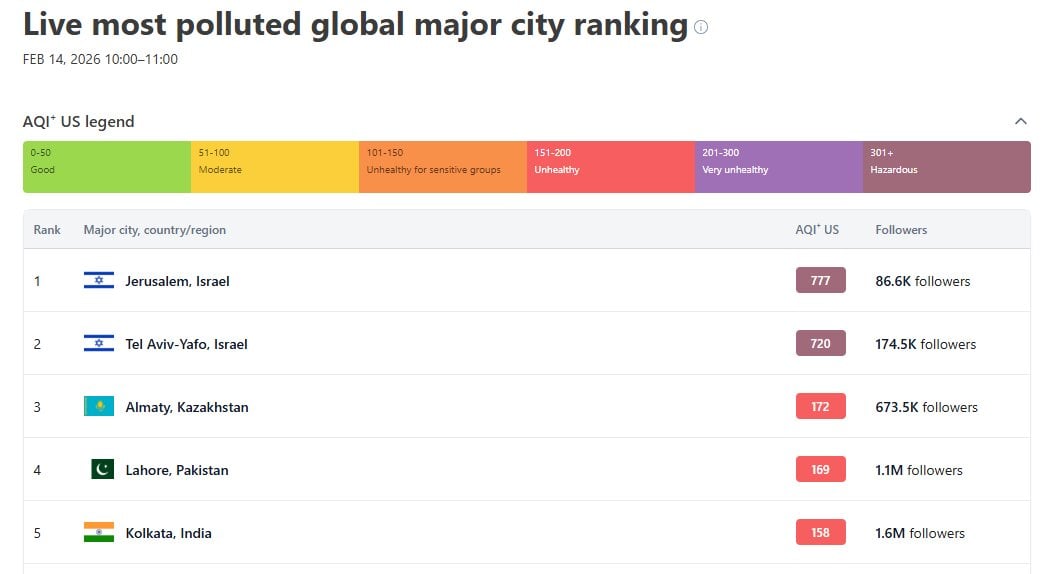
Air quality surveyors ranked Jerusalem and Tel Aviv as the world’s most polluted cities, with pollutant levels— specifically fine particles —exceeding “hazardous” levels in many parts of Israel.
Air quality monitoring site IQAir listed the Israeli cities above Almaty, Kazakhstan; Lahore, Pakistan and Kolkata, India.
The Health Ministry recommended that populations sensitive to dust —people with heart or lung conditions, the elderly, children, and pregnant women — avoid strenuous outdoor activity.
Other health recommendations included closing windows, wearing a mask—even indoors —and running an air purifier.
Environmental Protection Agency monitoring stations recorded a severe drop in quality starting around 3 a.m. as strong winds brought in clouds of dust from North Africa and the Sahara.
By noon, Israel’s Meteorological Service updated that the haze was beginning to subside and move eastward. It said visibility was expected to improve alongside air quality.
However, it still warned of winds of at least 55 kilometers (34 miles) per hour, with gusts up to 65 kilometers (40 miles) per hour.
Additionally, it advised against ocean swimming, noting that waters were “rough to very rough” due to strong winds and warning of at least 8-foot waves along the coast of central Israel.
This came amid forecasts of potential rainfall across parts of the country, while Mount Hermon in the north received another snowfall after its first of the season late last year.

No comments:
Post a Comment