“I don’t speak because I have the power to speak; I speak because I don’t have the power to remain silent.” Rav Kook z"l

Sunday, June 7, 2015

On the Rabbi Riskin Saga: Don’t Disqualify the Torah Scroll

The writer is Head of Yeshivat Har Bracha and a prolific author on Jewish Law, whose works include the series on Jewish law "Pininei Halacha" and a popular weekly column "Revivim" in the Besheva newspaper. His books "The Laws of Prayer" "The Laws of Passover" and "Nation, Land, Army" are presently being translated into English. Other articles by Rabbi Melamed can be viewed at: www.yhb.org.il/1

It was recently reported that the Council of the Chief Rabbinate has expressed doubt as to whether to permit Rabbi Shlomo Riskin from staying on as chief municipal rabbi of Efrat despite recently turning 75.
The hearing ordinarily would have been nothing more than a procedural matter. But several members of the council evidently aimed to prevent Rabbi Riskin from continuing in his capacity as a result of their objections.

This, then, is the appropriate time to take a stand and praise Rabbi Riskin, a righteous, wise leader who has done extraordinary things.

Rabbi Riskin was born into a non-religious, poverty-stricken family.  But from a young age, of his own free will and with the help of his grandmother, he began making his way toward the Torah and religious observance. Being a prodigy and an outstanding student, he was accepted to Harvard, the most prestigious university in the world, with a full scholarship. By choosing to study there, he would have guaranteed his professional and financial future: no door is closed to Harvard graduates.

It was a once in a lifetime opportunity, a temptation that few could resist. Yet Rabbi Riskin declined the scholarship and instead made his way to Yeshiva University, which also took notice of his abilities and granted him a full scholarship.
Since then, he has dedicated his life to Torah.

As a young, gifted, and charismatic rabbi, a captivating speaker with the ability to lift up the souls of his audience and draw them near to Torah and religious observance, Rabbi Riskin earned special esteem in the United States. Successful, educated individuals also found meaning in his words of Torah and were privileged to become acquainted with Jewish tradition under his guidance. “There was truthful Torah in his mouth, and he brought many back from sin.” The future that awaited him was that of a leader of the American-Jewish community.

Yet before even turning 40, inspired by pure faith in God and His Torah, he gave up his position in the United States and made a decision to immigrate to Israel.
In so doing, he gave up what had been his main skill in his work: his command of the English language, which had brought him the success he enjoyed in the United States. 

True, he learned to speak Hebrew excellently. but they say that in English few can parallel his rhetorical skills. Thanks to his vision, abilities, and leadership, he was able to bring many members of his community to Israel in his wake. He established an Israeli city at the heart of whose cultural life are the study of Torah and religious observance, whose residents enjoy a high standard of living and contribute to the economic, scientific, and social development of the State of Israel.

His 'aliyah' to Israel was felt by hundreds, even thousands, who followed in his footsteps to new  homes in Efrat and throughout Israel, while also benefiting from the enhanced religious life implicit in such a change. Never slowing, Rabbi Riskin successfully established yeshivot and educational institutions for boys and girls in Gush Etzion and Jerusalem. Drawing on incredible sources of energy, he still makes his way to all of these institutions, where he teaches, speaks, illuminates, and imparts to his students the excitement of a life centered on Torah and Judaism.
Yet when he arrived in Israel, he was guaranteed nothing. He came with little more than the shirt on his back.

Western Aliyah to Israel

Unfortunately, though we are not always aware of it, the vast majority of those who have immigrated to Israel in modern times have come from countries where Jews were subject to persecution and poverty. Immigration from Western countries, particularly the United States, is perhaps the most impressive of all.
I therefore have a deep appreciation of Rabbi Riskin as well as all other immigrants from the United States.

A Difference of Approach

There are most definitely different approaches to various issues in Jewish law. This always has been the case in Jewish discourse, whether between the sages of the Mishnah, those of the Gemara, the luminaries of Geonic Babylonia, the scholars of the medieval era, or those of the modern period. Sometimes the differences stem from people’s different characters, as with Shammai and Hillel. Other times they stem from differences in background or intellectual method. Concerning these issues, our sages said (Ḥagigah 3b), “‘Masters of assemblies’ are those scholars who sit, some in this faction and some in that, and occupy themselves with the Torah. Some say it is impure; others say it is pure. Some forbid; others permit. Some declare it invalid; others declare it valid.

Lest a person say, ‘Then how can I study the Torah?’ the verse states that all were ‘given by a single shepherd’: a single God gave them, a single leader said them, from the mouth of the Lord of all creatures, blessed is He, as is stated, ‘God stated all of these things.’ So you, too, make your ears a funnel and develop a discerning heart so that you can hear the words of those who say it is impure and the words of those who say it is pure, the words of those who forbid and the words of those who permit, the words of those who declare it invalid and the words of those who declare it valid.

American Jewry

Rabbi Riskin’s American background plays an important part in his pursuits: American Jews and immigrants from the United States stand at the forefront of the struggle with Western culture and its principles of liberalism and equality, including feminism.

Out of their faithfulness to the Torah, Rabbi Riskin and his colleagues have forged a path to contend with these major and important questions. Among American rabbis, too, there are different approaches: how much to open up and how much to close, what to bring near and what to keep distant.
Sometimes, other rabbis, including myself, prefer other solutions. Sometimes this preference stems from habits of observance to which we are devoted, sometimes from the fact that we believe a certain way is more appropriate. For the most part, these differences of opinion and practice pertain to questions of education and society, rather than to questions of practice per se. Time will tell what advantages and disadvantages each path contains. In any event, we must not seek to delegitimize Rabbi Riskin’s path, which is one of the most important approaches to religious observance in our day.

A Whole Torah Scroll

If a single letter is missing from a Torah scroll, it is unfit for use, and the same holds true for the pan-Jewish religious world: every true Jewish scholar has a letter in the Torah, and any person who excludes one of these scholars makes his own Torah scroll unfit for use. Any offense against Rabbi Riskin’s service in the rabbinate is equivalent to the obliteration of whole sections of the Torah.

I imagine that it was only out of ignorance that the Council of the Chief Rabbinate entertained doubts with regard to Rabbi Riskin. I am confident that once they have heard a bit of his reverence, erudition, and rectitude, the majority of the members of the rabbinical council will take his side.
If, heaven forbid, they reach a contrary decision, Rabbi Riskin’s dignity will not be harmed. His standing in his community and his institutions will keep rising, and his influence will become even greater. However, the public standing of the Chief Rabbinate as the public representative of the Torah of all Jews will be weakened when it becomes known that the Torah scroll it represents is deficient and unfit.

Policy of the Chief Rabbinate

Some have argued that the Chief Rabbinate should draw a line that all rabbis must follow, and Rabbi Riskin is not following the line that was drawn concerning such issues as conversion.
True, it is desirable that the Rabbinate take a position in pressing matters of public importance—but in order to do so, it must engage in a deep, serious discussion of each of these issues, a discussion of Talmudic, medieval, and modern literature that analyzes the reality of the matter at hand in all its dimensions. In order to expedite such a discussion, rabbis who are active in the given area would have to study various books and articles ahead of time, and then the discussion of every issue would continue for at least a few whole days.

Unfortunately, today no serious discussion is held concerning any important matter, whether in the Rabbinate or in any other religious entity. For instance, when it comes to conversion, Rabbi Ḥaim Amsalem wrote a very respectable book that is deserving of discussion. True, I draw different conclusions from his, but in objecting to what he wrote most of his opponents offer worthless arguments that rely on violence such as is accepted in Haredi circles.

I must add that despite the great value of arriving at a consensual position on every issue, such a position must not come at the expense of rabbinic discretion. Even when the Great Sanhedrin held session, local courts enjoyed a certain degree of authority, because fundamentally this position is not a thin line, but a divinely sanctioned field, a field in whose scope there are different practices and approaches thanks to which the Oral Torah becomes richer and greater.

All the more so today, when there is no Great Sanhedrin that traces its authority directly to Moses, must the Rabbinate not set a rigid line that seeks to disqualify religious perspectives of substance. The lesser the standing and authority of the Chief Rabbinate, the more it must take the various perspectives into consideration in arriving at its position. This is how the rabbis of the Jewish people carried themselves in previous generations.

“One Law Shall There Be for You All”

Aside from anything else, a single law must apply to all. When the Council of the Chief Rabbinate declines to react to profound challenges to its views and its dignity on the part of rabbis belonging to the haredi stream, who violently reject its kashrut supervision and treat the chief rabbis and municipal and neighborhood rabbis with contempt, it must also act tolerantly and fondly toward rabbis such as Rabbi Riskin, who respect the Chief Rabbinate but sometimes take a different track.

In today’s reality, the Rabbinate does not go out of its way immediately to dismiss rabbis who, contrary to the rules of Jewish law, disqualify conversions performed by representatives of the Rabbinate. It continues to recognize kosher supervision services, marriages, and conversions by “rabbis” who have the gall to publicly dismiss commandments of the Torah, such as the duty to settle the Land of Israel and defend the nation of Israel through military service, or deprecate the good that God bestowed on us with the establishment of the state and denigrate those who recite the Psalms of Praise on Independence Day.

In such with today’s reality, the Rabbinate must restrain itself from taking action against a rabbi whose reverence, deeds, and erudition are greater than those Haredi “rabbis” whom it is overly careful not to slight.

Friday, June 5, 2015

Belz Wedding! Where is the bride?

There are at least 45 UTube clips of the recent Belzer Wedding, but I think that the Chussin must have married himself, because there isn't one single clip showing any women! 
Women, according to Belz, were created for procreation only, they make them shave their heads to make them look ugly and then they hide them in the kitchen. But, I thought that the Kallah would at least show up to the wedding..... No such luck!
Mazel Tov.....Rebbe!

Thursday, June 4, 2015

Israeli Partner Weighing Massive Lawsuit Against Orange

Haim Saban
In response to the announcement Thursday by French-based cell phone company Orange that it wants to cut ties with Partner, the Israeli company that franchises its name in the Jewish state, Partner is considering launching a massive lawsuit against the company.
Billionaire Haim Saban, the US-based majority shareholder of Partner, told Channel 2 on Thursday night that Orange "gave in to pressure from all sorts of anti-Semitic bodies. In every generation they rise against us to destroy us; we are strong and we will be unified and fight against them."
The flare-up started on Wednesday, when Orange CEO Stephane Richard said in Cairo that he wanted to "dump" Israel "tomorrow" if he could.

Given that Orange is partially publicly owned by the French government, Saban noted that "the French government should have gotten up and said its piece, and announce that it is completely disconnected from the statements of the Orange CEO."

Speaking to Yediot Aharonoth, Saban explained that "Partner is completely an Israeli company. We signed a contract with them and we are considering our steps in response to the declaration."

Hinting at the potential lawsuit, Partner CEO Haim Romano wrote employees on Thursday saying, "if Orange's owner France Telecom wishes to end its association with us, we will be happy to do so in return for the hundreds of millions of euros we have invested in the brand name Orange over the years. We will use this money to invest in our customers, and citizens, and our country."

Saban noted that Orange recently signed a contract with Partner for ten years, explaining, "Orange is a brand name and Partner is the Israeli company with the exclusive rights to use the Orange name in Israel. Threats won't deter me. I'll continue to work in Israel and lead the national struggle for it (Israel)."
Commenting on Richard's statements, Saban said, "no CEO of a foreign company will dictate to us who to serve, where to serve and when to serve the state of Israel," responding to the apparent motive of Orange's move being in the fact that IDF soldiers serving in Judea and Samaria are given cell phone coverage by the company.

The struggle against the boycott movement against Israel is "a national issue of the highest importance and I was enlisted to it even before things directly affected a company I own," said Saban.
"It's important that we be able to locate those who encourage the boycott against Israel and act against them with full force," he said. "At the same time, it's important that we show internal solidarity and defend those who may be harmed by this boycott. I call on the public in Israel to embrace Partner and to join us."

Nothing official received yet

Partner CEO Romano also responded to the decision on Thursday night, saying that Orange can't cancel its deal with Partner "unless it pays a lot."
"We haven't received anything official, and it could be that this is an excuse or their way to avoid a process that maybe they want to start without coming to say that it's a political process, instead explaining it as part of a strategic tactic."
"But it really doesn't matter to us so much how they perceive it," he continued. "We haven't received anything official and if we receive something official - we'll address it. For the meantime we still are demanding an apology and clarifications on what their CEO said."

In a joint statement by outgoing CEO Romano and incoming Partner CEO Itzik Benevisti, the two said, "Partner has a long term agreement with France Telecom which provides Partner with exclusive usage rights to the brand name Orange in Israel. Partner has not received any sort of announcement regarding a cancellation of this agreement."

"We note that France Telecom does not have the right to end the agreement for reasons of convenience, other than as a result of a change in its policy in terms of giving usage permits," they continued, going on to note the severity of Richard's statements and how their company is weighing its next steps.

Earlier on Thursday Prime Minister Binyamin Netanyahu made mention of the Orange fiasco, noting that the company is partially owned by the French government and demanding that the government condemn the statements and moves of the company.

Vishnitz Rebbe of Monsey's oldest son HaRav Pinchas Shalom Hager passes away

 HaRav Pinchas Shalom Hager ZATZAL, the oldest son of the Vishnitz Rebbe of Monsey Shlita. Passed away, he was 67 years old.
Harav Pinchas Sholom Hager z"l


Rav Pinchas Shalom served as the Rov of the Vishnitz Monsey Kehilla in Boro Park, and ran the Kollelim, Yeshivos, and girls schools. He served as the Mesader Kedushin for just about every Vishnitzer Chasunah, and was deeply involved in the lives of the Mishpachos of the Vishnitz Monsey Kehilla.

Last month Rav Pinchas Shalom went to Mount Sinai Hospital for a medical, and his condition unexpectedly turned critical the next day. He remained in serious condition for the past four weeks. Early this morning his vital organs began shutting down, and was Niftar at around 10:25AM.
He leaves behind a wife, three sons, and six married daughters.

Tonight his brother Rav Mendel Hager is marrying off a granddaughter in Eretz Yisroel.

The Levaya is scheduled for 2:00PM today at the Vishnitz Shul at 53rd Street and New Utrecht Avenue. The Levaya will then proceed to Monsey where a Levaya will be held at the main Vishnitz Bais Medrash.
Boruch Dayan Ha’Emmes

Muslim Shot in Boston Planned to Kill Jewish Blogger

A Muslim who was fatally shot on Tuesday after waving a military knife at law enforcement officers in Boston was originally plotting to behead Jewish blogger Pamela Geller, law enforcement sources told CNN on Wednesday.

Pamela Geller
However, Usaamah Rahim, a 26-year-old security guard who officials believe was radicalized by ISIS and other extremists, decided instead to target the "boys in blue," a reference to police, according to court documents.
"I can't wait that long," he said of the original beheading plan, according to an FBI affidavit filed in federal court in Boston on Wednesday.

Gelller, the founder and president of the American Freedom Defense Initiative (AFDI), is known for her campaign against extremist Muslims, which has featured among other things prominent bus ads criticizing Muslim anti-Semitism.
Geller drew national attention last month after an off-duty police officer thwarted an attack at her organization's contest for Prophet Mohammed drawings in Garland, Texas.
"They targeted me for violating Sharia blasphemy laws. They mean to kill everyone who doesn't do their bidding and abide by their law voluntarily," Geller told CNN's Erin Burnett at the time.

"This is a showdown for American freedom. Will we stand against this savagery or bow down to them and silence ourselves?" added Geller, who said that she's had an "army of security" since last month's thwarted attack.
"This is what is required just to show a cartoon in America, 2015," she said. "It's striking. It's devastating, and people need to understand what's at stake. I mean, if we surrender on this point, what will we surrender next?"

According to CNN, about two hours before Rahim's confrontation Tuesday with officers on a Boston street, he allegedly told an associate he was "going to ... go after them, those boys in blue. 'Cause ... it's the easiest target," the documents say.

Rahim's alleged associate, David Wright, 25, appeared in a 
Boston court on Wednesday to face a charge of obstructing a federal investigation by destroying electronic evidence on Rahim's smartphone.

A detention hearing was scheduled for June 19 after prosecutors said he was a flight risk, the report said.
Wright allegedly attempted to destroy co-conspirator Rahim's cell phone and conceal evidence of their plans, according to the documents. He faces a maximum penalty of five years in prison if convicted.

Big Segula for Parnassah "Go to work"

Loose translation:

A lady went to Rabbi Ben-Zion Muztpi complaining that her financial situation is very bad, because she does not work and her husband is learning so she is asking for  a segulah for parnassah.
The Rabbi answered her "tell your husband to work at least (lchol ha'pachois") a half a day"

Wednesday, June 3, 2015

BDS is anti-Semitism in new clothes

Ayelet Sheked
The boycott and divestment  sanctions movement is the new anti-Semitism and wants to destroy Israel, Justice Minister Ayelet Shaked said Wednesday, in response to a motion to the agenda from coalition and opposition MKs calling to fight those who seek to delegitimize Israel.

The discussion was marked by shouting matches over whether BDS is an anti-Israel and anti-Semitic movement or simply seeks to bring an end to Israel's presence in areas liberated in 1967.

"BDS opposes Israel as the Jewish state. It wants to blacken us and destroy us as a Jewish and democratic state," Shaked explained. "The boycotters don't talk about Judea and Samaria, they talk about the state of Israel."

According to Shaked "it's not politically correct to be anti-Semitic today, but it's super-in to be anti-Israel," and as such, "people used to delegitimize the Jews and now they do it to our state."

"BDS is anti-Semitism in new clothes," she added.

Shaked called to fight back against BDS and "boycott the boycotters" and listed the many government ministries, including hers, that are taking part in the efforts to fight delegitimization, bringing MK Bassel Ghattas (Joint List) to interject: "It won't work."

"Israel will continue to be a light unto the nations," Shaked vowed.

Minister-Without-Portfolio Ofir Akunis posited: "Maybe, when radical Islam takes over Europe, people there will understand the real meaning of occupation."

After incessant interruptions from Joint List MKs, Akunis shouted to them: "Your narrative is a lie. It is violent and it encourages terrorism...Your narrative was based on terrorism even before the State of Israel was founded!"

Referring to the ambassadorial appointment Akunis is seeking, MK Ahmed Tibi (Joint List) shouted to Akunis to "go to the UN."

"OK, you go to Arafat's grave and I'll go to the UN. I"m not going to let someone who was an advisor to Arafat lecture me," Akunis said to Tibi, who used to work for the PLO chairman.

MK Nachman Shai (Labor) opened the discussion by saying that diplomatic pressure on apartheid South Africa began with its ejection from FIFA, and that is what the Palestinians were trying to do to Israel.

"We cannot let history repeat itself. If we do not act here and now, if we do not initiate diplomatic processes to break the blockade on us, we will be left alone," he warned.

Yesh Atid MK Aliza Lavie warned that the government does not have a "clear policy, no action, no strategy, no plan with a budget" to fight delegitimization.

"Israel is on the verge of the abyss, yet we're putting out fires instead of taking initiative," she lamented.

MK Michal Rosin repeated statements that BDS is "not against the occupation, they're anti-Semitic" in a mocking tone, adding "oy oy."

"The real issue is the policy of continuing the occupation and managing the conflict," she claimed.

MK Michael Oren (Kulanu), former Ambassador to the US, responded that "this isn't about settlements. BDS wants to erase Israel from the map."

Oren credited NGOs like StandWithUs, CAMERA and AIPAC for doing "holy work" to combat BDS, but criticized the government for "abandoning an important topic for our security."

"We have to take our security into our hands and launch a campaign against this strategic danger, which could become existential," he stated.

Oren called the cancellation of the vote to eject Israel from FIFA a victory, but warned "we cannot rest on our laurels. The danger hasn't passed; it's gotten worse."

Tibi, who took the stand next, asked Oren if he thinks it's alright that Israel doesn't let Palestinian athletes play and whether politics and sports should mix.

"Do you oppose BDS?" Oren retorted.

"Like a real Jew, he answers a question with a question," Tibi quipped.

MK Anat Berko (Likud), pointed out that there is precedent of athletes and other VIPs being allowed out of Gaza taking part in terrorist activities; therefore, athletes must go through checkpoints, as well.

When Berko called Palestinian Football Association President Jibril Rajoub "a terrorist from a family of terrorists," a Joint List MK asked "Who are you to decide?"

Berko is a world-renown expert on terrorism, who lectured on the topic at George Washington University and the Interdisciplinary Center Herzliya.

The Likud MK recounted that when she and Oren started a caucus to fight delegitimization, the only factions whose members would not join were Meretz and the Joint List.

"We will fight delegitimization from the inside and the outside," she said.

"What does that mean?" Rosin asked.

"That you wouldn't join the battle," Berko retorted. "You're delusional. You think no one tried to delegitimize Israel before 1967?"

Meretz chairwoman Zehava Gal-On took umbrage with some MKs' rhetoric, saying her party "opposes boycotts of Israel, we just can't stand how you act like victims!

"You act like whoever criticizes the occupation is an anti-Semite. Calm down. Netanyahu's policies are what encourages those who boycott us," she stated.

Zionist Union MK Eyal Ben-Reuven pointed out that it was Unity Day, in memory of the three teens murdered by Palestinians last year, and called for MKs to unite to fight delegitimization, saying "there is no coalition and opposition on this matter."

Ghattas, however, disagreed with the sentiment.

"Even some people on the Left need to wake up," he said. "The world is sanctioning Israel because of the occupation."

In his usual flippant fashion, MK Oren Hazan (Likud) said to Joint List MKs: "You're Arab citizens of Israel. If you don't like it here, leave...We're here to stay, I'm not so sure about you.

"People keep talking about the occupation; I don't know about any occupation," he added. "The Land of Israel belongs to the people of Israel and not the Ishmaelites."

Livni, the Satmarer, says Israel Has No Choice But to 'Toe Obama's Line'


This Livni must be from the same gypsy tribe as the Romanian Satmars. Her demented thoughts and words are right out of the Satmar handbook "Al Hagilah" . 

There, in that booklet of the late Satmar Rebbe z"l, the Rebbe  who lived in a comfortable and safe house on Bedford Avenue in Brooklyn, stated that Israel should have followed the  advice of the President of the USA.
He screams and rants in that Sefer the insane and misinformed notion that the Israelis started the  the 6 day war, and should have listened to President Johnson  that was pleading with the Prime Minister of Israel, Levi Eshkol, to wait another couple of weeks because he was negotiating with Nasser not to go to war!

 How Insane? 

Nasser was screaming that he was going to wipe Israel off the map and marched his third army at the footsteps of Israel ....blockaded the Gulf of Aqaba , an international act of war, and had  Syria and Jordan  surrounding Israel with thousands of troops and tanks  .... and the Satmer SHIT"ah ...was that Israel should wait!

This idea wasn't a new one for the Satmar Rebbe z"l, he advocated the same policy pre-WW2, when the Nazis yemach shmom, were nipping at the borders of Hungary, the Rebbe advised his Chassidim to wait it out and not make Aliyah, but he didn't listen to his own advice and escaped with the help of the Zionists to Switzerland!
The Satmar SHIT'ah is that Israel should listen to the President of USA, Barack Hussein Obama...
How blind to the facts can one be?


The Israel-US Relations Lobby of the Knesset met Wednesday morning, to discuss the latest developments in the ongoing relationship between both countries. Among the participants in the event were former Israeli ambassador to the US and current Kulanu MK Michael Oren, and former Foreign Minister Tzipi Livni.

According to Livni, Israelis are too quick to judge American stances on issues affecting their country. “Many Israelis think that they are 'okay,' and that the problems with the relationship with the U.S. stem from their side,” whether due to the American desire to impose a two-state solution, or other reasons.

But Israelis should give the U.S. more credit, said Livni. “I can tell you that – as former Foreign Minister – that every single major IDF mission begins with a phone call to the White House. Either we can be an isolated state fighting our enemies, or we can be an ally of the greatest power in the world and fight our enemies.”

One reason the Palestinian Authority has toughened its stances recently – demanding a full Israeli withdrawal from Judea and Samaria and most of Jerusalem as the price of avoiding charges at the International Court of Justice – is because “they understand Prime Minister Netanyahu's weak point – Israel's relationship with the world. 

If the U.S., for example, decides to change its policy of vetoing anti-Israel measures in the UN Security Council, where would we be?
“We need to be sensitive to the current situation,” said Livni. “It doesn't matter if the we like the American president or dislike him. We have to work with him, Democrat or Republican. We cannot place all our eggs in one party's basket, preferring one over the other. Too much is at stake.”

In an interview Tuesday with Channel Two, U.S. President Barack H. Obama issued a threat to Israel, referring to his remarks after the recent Israeli elections when he said America would have to reassess its policy towards Israel, and clarifying that at the time he was referring to something specific. "If there are additional resolutions introduced in the United Nations...up until this point we have pushed away against European efforts for example, or other efforts. Because we've said, the only way this gets resolved is if the two parties worked together," he said, referring to European moves to unilaterally recognize the PA as a state.

Describing Netanyahu, Obama said, "I think that he also is someone who has been skeptical about the capacity of Israelis and Palestinians to come together on behalf of peace. I think that he is also a politician, who's concerned about keeping coalitions together and maintaining his office."
"Netanyahu…is somebody who's predisposed to think of security first. To think perhaps that peace is naive," he continued. "To see the worst possibilities, as opposed to the best possibilities in Arab partners or Palestinian partners, and so I do think that right now, those politics, and those fears are driving the government's response. And, I understand it, but…what may seem wise and prudent on the short-term, can actually end up being unwise over the long-term."

First they throw rocks on IDF soldiers then they burn down the apartment of the Mashgiach


When Roshei Yeshiva, Rabbonim, and other leaders of the Chareidie community keep their mouth shut and don't condemn the violence against their fellow brothers in uniform, then Hashem makes sure that this comes back to bite them!

A  yeshiva Bochur attending Yeshivas Lev Simcha, affiliated with the Ger Chassidus, located in Arad, set the room of the mashgiach ablaze over a dispute between them. The arson attack occurred last week and police launched an investigation after it was determined the fire was the result of arson. 

A 20-year-old talmid was taken into custody on motzei Shabbos 12 Sivan. The suspect is a resident of Ashdod.

Police report the suspect connected himself to the allegations against him and an indictment was filed while the prosecution wants the suspect held without bail. 

The suspect appeared before a Beersheva court on Tuesday, 15 Sivan. The suspect remains in jail for the time being.

Friends of the suspect and other talmidim in the yeshiva are having a most difficult time digesting the realities of the case. It is explained the fire occurred on a day that everyone traveled to a chasenah so no one was around in the yeshiva.

District Police Chief David Shariki added B”H the blaze was brought under control and no one was killed or injured. He confirms the suspect connected himself to the crime of which he stands accused, also confirming police are asking that the suspect is denied bail.

Frum lady born In Auschwitz Testifies In Groening Trial: Forgiveness Is Impossible

Witness Angela Orosz-Richt (L), born in Auschwitz, sits next to her lawyer Heinrich Rothmann in the courtroom in Lueneburg, Germany, 02 June 2015. Former SS-Mann Oskar Groening stands trial in Lueneburg 70 years after the end of the Nazi dictatorship. The prosecution accuses him of complicity in at least 300,000 cases of murder in the concentration camp Auschwitz.  EPA/PHILIPP SCHULZE

A Montreal woman, one of only two surviving babies to have been born in Auschwitz, spoke Tuesday at the war crimes trial of 93 year old Oskar Groening, who is being charged with complicity in the murder of 300,000 Jews in the notorious death camp
70 year old Angela Orosz-Richt, who was born just weeks before the liberation of Auschwitz, originally had no interest in taking part in the trial, being held in Lunenberg, Germany, according to her son, Lakewood resident Yubie Richt. 
Orosz-Richt was persuaded to return to the death camp during the recent 70th anniversary celebration of the liberation of Auschwitz, where she saw the places her mother, Vera Bein, had spoken about and the place where her father, Tibor Bein, died.
“She met a lawyer on that trip who told her that he is trying Nazis in court and he really wanted her to testify but she kept on brushing it off,” Richt told VIN News.  “Her step brother had gone and testified and found it to be a vindicating experience.”
Orosz-Richt began considering testifying in the Groening trial but it was the testimony of another survivor that convinced her that she needed to share her mother’s story.
“Her main motivation was Eva Kor, who appeared in court and said she forgives the Nazis,” said Richt. “My mother got physically sick from it and that is what she is fighting against. She is not fighting against the deniers. She is not fighting anti-Semitism. She is fighting that appearance and speaking out on behalf of others who refuse to forgive.”
In her appearance Tuesday, Orosz-Richt faced Groening and told him that she could never forgive the Nazis for decimating her family.  Orosz-Richt, who was born two months prematurely weighing a single kilo, spoke about her mother, who became a subject of medical experimentation in Auschwitz and her miraculous birth and survival under horrific conditions.
“I survived for a reason,” said Orosz-Richt. “I survive for a reason.  I have a mission. To speak for those who cannot speak for themselves. To carry the torch and tell my mother’s story and the story of the Holocaust of European Jewry. To stand and point an accusing finger at those responsible for the inhumanity into which I was born. Those who helped watched and profited from the terror. Those like you, Herr Groening.”
Alternately addressing both the court and Groening, Orosz-Richt described how her parents, who married in 1943, were deported to Auschwitz just one year later from the Hungarian town of Sarospatak.
“I heard that you, Herr Groening, described arrival at Auschwitz as orderly,” said Orosz-Richt in her testimony.  “To the Jews there, it was not. Instead it was traumatizing. We, I in my mother’s belly, were beaten and herded by SS men with whips and machine-guns shouting ‘Everyone out!’ ‘Schnell!’ ‘Leave your baggage on the train.’ There were SS men, your colleagues, Herr Groening, standing in watchtowers with machine guns and spotlights on us, watching the chaos. From up there, the madness may have seemed orderly, but down on the platform it was not. To her dying day, my mother was afraid of barking dogs, because of that day.”
Orosz-Richt said that her parents watched as new arrivals were sorted. The elderly, the frail, the children and the noticeably pregnant women, were sent to the left, where they were told they would be showering.
“These Jews were not showered-instead they were gassed,” said Orosz-Richt.  “Herded into gas chambers. Dead before their belongings had been collected and taken to the warehouse. It is a painful death from Zyklon B gas. A pesticide. It can take 20 minutes to die with foaming mouth and bleeding from various body parts. Horrible deaths, millions of children and adults, Herr Groening, and you knew what was happening. Because of this, for the rest of her life, my mother couldn’t take a shower. Just baths. After many years, she still couldn’t believe that it was water coming out of the shower, not gas.”
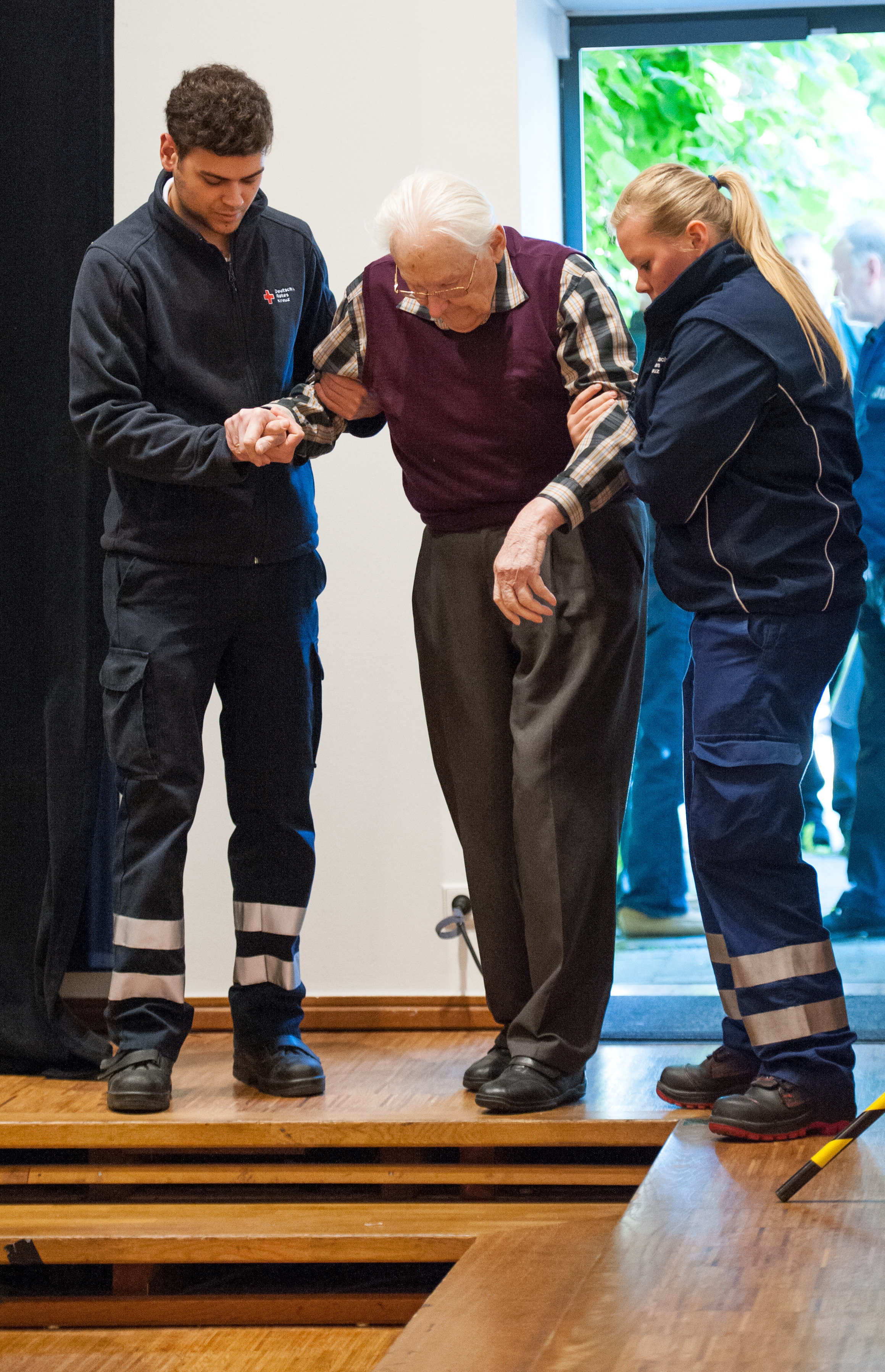
The defendant Oskar Groenig (C) is led into the courtroom in Lueneburg, Germany, 02 June 2015. Former SS-Mann Oskar Groening stands trial in Lueneburg 70 years after the end of the Nazi dictatorship. The prosecution accuses him of complicity in at least 300,000 cases of murder in the concentration camp Auschwitz.  EPA/PHILIPP SCHULZEThe defendant Oskar Groenig (C) is led into the courtroom in Lueneburg, Germany, 02 June 2015. Former SS-Mann Oskar Groening stands trial in Lueneburg 70 years after the end of the Nazi dictatorship. The prosecution accuses him of complicity in at least 300,000 cases of murder in the concentration camp Auschwitz.  EPA/PHILIPP SCHULZE
Despite telling Joseph Mengele, who was sorting the newly arrived prisoners, that she was pregnant, Vera Bein was stripped of her dignity and humanity as she was shaved, tattooed, given prison garb and sentenced to forced labor.  While she survived the backbreaking work, her husband did not.
Originally assigned to search for valuables in the possessions taken from newly arrived Jewish prisoners, Vera Bein was transferred to a heavy labor detail when she was five months pregnant.  Orosz-Richt said that her mother spent her days building roads and working in the fields.
“She told me, ‘If we found plants in the fields, animal food not even meant for human consumption, there was a celebration among us. It was as though we found treasure. Like a Sachertorte.  We shared it.  We ate it.’”
As her pregnancy progressed Vera Bein told her Blackaeltest that she was expecting.  While an admission of that nature would have normally been a death sentence, she was sent to a special barrack where she was charged with taking care of children, particularly the twins that became victims of Mengele’s science experiments.  In time, Vera Bein herself became a human guinea pig for Mengele and his team of “doctors,” selected for sterilization experiments in her seventh month of pregnancy.
“They injected a burning substance into her cervix,” testified Orosz-Richt.  “Right behind, in her uterus, was the fetus. Me. These injections were terrible, painful.  Injection one, the fetus moved to the left side….next day another injection, the fetus moved in the other direction. And they played that game for a while. Those experiments are the reason I do not have any brothers or sisters.”
Their demented scientific projects concluded, Vera Bein was sent back to her barracks.
“Because she was fed so little, I was so tiny that the pregnancy didn’t show,” said Orosz-Richt.  “If not for this we would have both been killed before I had taken my first breath.”
Orosz Richt was born on a cold December day on a top bunk in the barrack.
“That is how I came into this world,” said Orosz Richt. “In a barrack filled with children, none of whom knew I was born. I was so malnourished that I weight one kilo and was unable to cry.  This was the only reason I survived.”
Just three hours after giving birth to her daughter, Vera Bein was forced to go out into the cold for roll call.
“The whole time she was praying that I would still be alive when she returned to the barrack,” said Orosz-Richt. “It was winter, and the wooden shoes the inmates wore were dangerous because of snow and ice. If she fell, they would shoot her. She was shivering, no clothes, no shoes, but one thing was burning inside her: I have a child, I have to save her!”
One month later Auschwitz was liberated and a second child was born in Auschwitz.  Because the newborn’s mother did not have enough milk to nurse her son, Orosz-Richt somehow managed to nurse both babies, despite her own nutritional deficiencies.
It was eleven months later that Vera Bein was finally able to return to Hungary.  With her baby weighing just over six pounds, she went from doctor to doctor looking for someone who could help her sickly child.
“My mother went from doctor to doctor but none of them had any hope that they could help, or that I would grow into a healthy baby,” testified Orosz-Richt. “My mother was the only one convinced that I would live. People used to call her a crazy woman. They thought she had lost her mind in Auschwitz and that I was a doll, because I couldn’t move. I did not look like a human baby. I looked like a rag doll. One doctor held me upside down like a chicken, and said that if I raised my head there was a chance that I might survive, and he would help. I did! After that he cared for me for several years until my bones were strong enough to walk on. The legacy of Auschwitz, of my mother’s starvation and abuse, never disappeared completely. I stand less than 5 feet tall today.”
Addressing Groening, Orosz-Richt noted that today would have been her father’s birthday.
“Herr Groening, I am sure you visit your wife’s and your parents’ graves to pour out your heart, if you have one,” said Orosz- Richt.  “I cannot do that. I cannot go to my father’s grave to say a prayer, because he does not have a grave. His remains were burned and his ashes scattered around Auschwitz, maybe in the grounds of the camp, maybe shovelled into the forest or used as fertilizer on the surrounding fields. Auschwitz is my father’s grave.”
Even 70 years later, forgiving the murderers is impossible, according to Orosz-Richt.
“Herr Groening, how can I ever forgive? How can I ever forget? Although after the war my mother seemed to have put the horrors of Auschwitz into the back of her mind and lived as a happy and loving person, when she lay dying of cancer at the age of 71, in Toronto, the nightmares came back. She saw Mengele standing at the door of her hospital room. No amount of morphine could make him disappear. She died on January 28th because January 27th was the day Auschwitz was liberated and she said she just did not want to die on that day. ”
Orosz-Richt, who is expected to be the last to testify against Groening, concluded her testimony by reiterating her refusal to forgive the atrocities of the Holocaust.
“In memory of my father, who I never knew, and in memory of my mother who had given birth to me in those indescribable conditions, beaten by SS men, surviving on less than 400 calories a day, for that and for everyone you helped murder, I cannot forgive you, Herr Groening ... Because of my parents’ and my wider family’s fate, the terror of Auschwitz has been and will be with me all my life. The past is present. This makes it impossible for me to forget or forgive those who were responsible for Auschwitz, the many concentration camps around Europe and the murders of six million Jews. Six million innocent people killed only because they were Jews.”