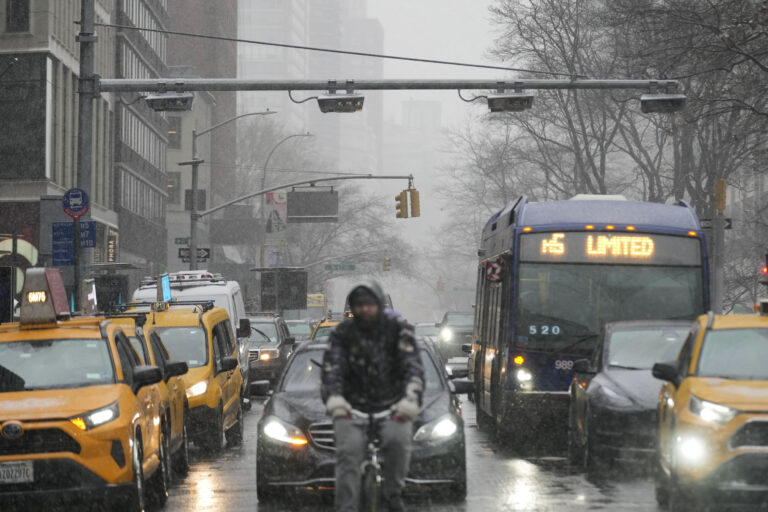
A new toll on drivers entering the core of Manhattan brought modest but measurable traffic reductions to New York City’s heavily-gridlocked streets in its first week of operation, according to preliminary data released Monday by the state’s transit authority.
Known as “congestion pricing,” the first-in-the-nation program launched on Jan. 5, collecting $9 from most passenger cars entering the city below Central Park during peak hours and higher fees on trucks and other vehicles. In the days since, total traffic in the tolling zone has dropped by 7.5% — or roughly 43,000 cars per day — compared to the equivalent period last year, Metropolitan Transportation Authority officials said.
“Just look out the window: there is less traffic, quieter streets, and we think everyone has seen it,” said Juliette Michaelson, the MTA deputy chief of policy and external relations. “Traffic patterns are already changing and they will continue to change.”
First proposed decades ago, the program is intended to raise billions of dollars in revenue for the cash-strapped MTA while easing congestion on the city’s streets. It follows similar initiatives in London, Singapore and Stockholm, which also saw immediate reductions in traffic after their tolls went live.
The effect in New York has been most pronounced during the morning rush hour period, with travel times over certain crossings — including the typically traffic-choked Holland and Lincoln tunnels that run under the Hudson River from New Jersey — falling by 40% or more, Michaelson said.
Despite anecdotal reports of more crowded train cars, she said the agency had not clocked a noticeable increase in subway users, largely because the baseline number of riders — over 3 million daily — is so high. However, a handful of bus routes originating in Brooklyn and Staten Island had seen an increase in ridership the previous week.
Within the congestion zone, the immediate impact has been more mixed. While certain thoroughfares have seen traffic reductions, others routes have stayed largely the same. A Midtown crosstown bus widely derided as New York’s slowest saw its runtime shaved by only a minute, according to MTA data. And there has been little noticeable change during the overnight hours, when the toll for passenger cars goes down to $2.25, officials said.
Bob Pishue, an analyst with INRIX, a traffic-data analytics company, said the MTA’s initial data matched the findings of the firm, which has been comparing drivers’ GPS data before and after the program launched.
“Fewer people are coming into Manhattan, but we’re not seeing a significant impact on speeds within the zone yet,” he said. “Some trips are faster, some are slower.”
He cautioned against drawing broad conclusions after barely a week, noting that many drivers were likely taking a “wait and see” approach.
Congestion pricing has sharply divided residents of New York and neighboring areas, touching off protests from many drivers, along with threats of sabotage and viral videos on how to evade the fee.
Proponents of congestion pricing, meanwhile, have hailed its launch as a transformative moment for a city contending with worsening traffic and aging public transportation infrastructure desperately in need of upgrades.
Initially slated to begin in June, the program was halted at the last moment by New York Gov. Kathy Hochul. A one-time supporter of the program, the Democrat said her position changed following conversations with “ordinary” New Yorkers, including a Manhattan diner owner concerned the toll would disincentivize customers driving in from New Jersey.
Hochul later revived the program but at the lower price of $9 for most drivers, down from the $15 fee initially approved by the state.
Tarek Soliman, the owner of Comfort Diner in midtown Manhattan, said he had spoken directly with the governor about his fears of losing New Jersey customers. While he said it was too early to tell if the program had hurt business, the new fee was already having at least one impact on him.
“Every weekend, I used to drive to the garage next to the diner,” Soliman, a resident of Astoria, Queens, said by phone Monday. “Now I don’t drive. I take the subway.”