“I don’t speak because I have the power to speak; I speak because I don’t have the power to remain silent.” Rav Kook z"l

Thursday, May 29, 2025

Ori Megidish recounts: I asked for signs from God while in captivity - and received them


 Ori Megidish, the first hostage who was rescued from captivity in Gaza, revealed on Channel 12’s program “Uvda”, which aired on Wednesday evening, the personal story behind the hardships of her captivity—and the faith that never left her for a moment.

"I had faith that God was by my side, watching over me and would get me out of there," Megidish said, adding that she repeatedly sought signs from above: "I would ask a question, like if I’m supposed to get out of here, let there be a boom. And then there was a boom. There were all sorts of signs."

On another occasion, she asked God to see a butterfly as a sign from heaven. "Suddenly, one of the captors pulled out a toy shaped like a very colorful butterfly. I started smiling, even though I had stitches in my face—I felt He was with me."

During her third Shabbat in captivity, IDF bombings struck the house where she was held. "The ceiling collapsed, the house was engulfed in flames. I didn’t even feel that I was injured." Only later did she realize she had a skull fracture. Megidish recalled that the doctors who treated her in captivity stitched her face without anesthesia. "It was pain you can’t describe," she recounted.

At the moment of her rescue, Megidish was asleep. "There’s gunfire outside, and when I realize something is happening, I go behind the fridge and crouch down. I shout in Hebrew, I don’t know why, but it was like I felt, I don’t know, that this was a rescue."

Standing before her was a soldier who looked like a local, with no identifying marks. "I was conflicted—thinking it could have been another kidnapping, at that level. It could have happened." As they began to drive away, Megidish heard the soldier speaking in Hebrew. "I remember exchanging glances with him, and I saw how excited he was."

Israel Quietly Used Laser System to Down Hezbollah Drones During War


The Israeli military revealed it had secretly deployed a new laser interception system during last year’s conflict with Hezbollah, successfully downing dozens of explosive-laden drones over northern Israel.

The system, a compact version of Rafael’s “Iron Beam,” was rushed into use amid a wave of more than 300 drone attacks. The Defense Ministry said the system delivered “particularly high interception achievements,” protecting both civilians and strategic assets.

The full-scale Iron Beam is expected to be handed over to the IDF later this year.


Video Player

Wednesday, May 28, 2025

Chassidishe Guy Feeling up Girls in Yerushalayim ....Turns out He is a Girl himself!


American Yeshivah Bochrim March to Meah Shearim and Force Chassidishe Scumbag to Remove Palestinian Flag!


Yesterday in Meah Shearim, a group of American "Yeshiva Bucharim" made sure that a Neturei Karta fan removed his Palestinian flag from his porch. 

Macron tried to embarrass the Jews last week, and he ended up embarrassed in front of the entire world by his wife.

 “Whoever blesses the Jews is blessed, and whoever curses them is cursed” - Genesis 12:3


Fired Federal Attorney who wrongfully sent Jan 6 prisoners to prison cries about losing job.


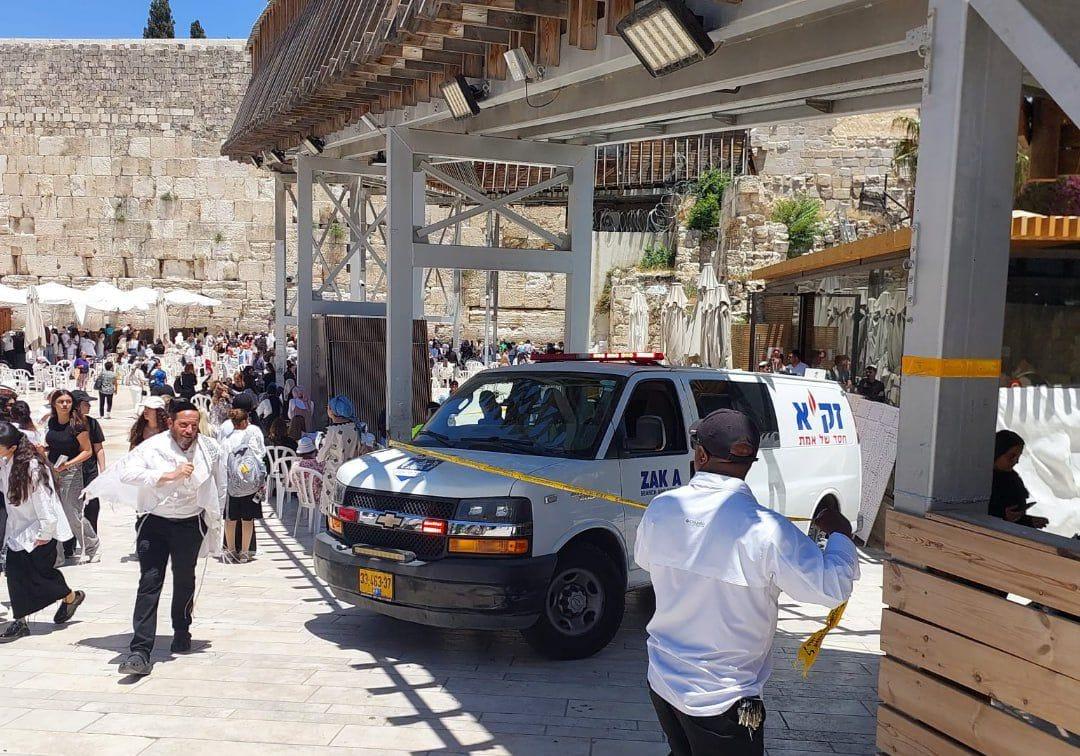
Woman in Her 60s Found Lifeless at the Kotel


A woman collapsed this afternoon in the women’s section of the Kotel plaza. 

Worshippers who noticed her hunched over a Sefer Tehilim alerted emergency services, but Magen David Adom teams were forced to pronounce her dead at the scene after finding no signs of life.

Kristi Noem meets Netanyahu in Israel, warns him not to submarine Iran talks


 Department of Homeland Security Secretary Kristi Noem had a “candid” conversation with Israeli Prime Minister Benjamin Netanyahu over the weekend about Iran’s nuclear capabilities — delivering a message “directly” from President Trump, The Post learned.

Noem travelled to Israel and met with Netanyahu on Trump’s behalf, where the two spoke about Israel’s security and visited the border with Gaza. She also offered the US’s condolences for Sarah Milgrim and Yaron Lischinsky, the two Israeli embassy workers who were shot in a terrorist attack in DC last week.

The meeting was part of Noem’s larger jaunt to Italy, Bahrain and Poland, where she also spoke to world leaders about advancing US security interests.

While in Israel, “the Secretary and Prime Minister had a candid conversation where the Secretary reiterated POTUS’s desire to bring peace to the region and for Iran to never have a nuclear weapon,” a readout of the meeting read.

Trump has been adamant on Iran not acquiring a nuclear weapon and has made it his foreign policy mission to enforce the message that the US will not stop until Tehran abandons the idea.

While the contents of the conversation weren’t entirely clear, Israel has reportedly been considering striking Iran’s nuclear facilities if the US-Iran talks don’t work out.

However, Trump has warned Netanyahu that he would rather achieve the goal diplomatically, instead of the “more severe and negative option,” White House press secretary Karoline Leavitt said last week.

“President Trump specifically sent me here to have a conversation with the prime minister about how those negotiations are going and how important it is that we stay united and let this process play out,” Noem told “Fox & Friends” Monday about her conversation with Netanyahu.

“It was a very candid conversation.”

Trump pulled out of the Obama-era Joint Comprehensive Plan of Action (JCPOA) in 2018, but has made clear that he will ensure Iran doesn’t achieve nuclear capability under his watch. The president has directed his administration to hold talks with Tehran about stopping their nuclear program — and has threatened to bomb their atomic sites.

“Well, we could actually blow ’em up. Blow ’em up, or just de-nuke ’em,” Trump told Hugh Hewitt on May 7 about Iran’s nuclear sites. “But there are only two alternatives, blow ’em up nicely or blow ’em up viciously.”

Noem also held a candle lighting ceremony and tree planting for Milgrim and Lischinsky alongside Israeli Foreign Minister Gideon Saar.

In Italy, Noem spoke to Italian Minister of the Interior Matteo Piantedosi about the US and Italy working together to combat “transnational crime, including efforts to disrupt human trafficking, smuggling networks, and organized criminal activity,” the readout said.

Noem also went to Bahrain, where she met with King Hamad bin Isa Al Khalifa and spoke to US Coast Guard personnel, and Poland, where she met with President Andrzej Duda about US bilateral relations.

Germany again Threatening Jews!!!


 Germany's foreign minister, Johann Wadephul, on Tuesday warned Israel of unspecified measures and declared Berlin would cease exporting weapons used in violation of humanitarian law, Reuters reported.

This marks the most severe rebuke yet from Germany, delivered in concert with Chancellor Friedrich Merz, as international pressure mounts on Israel regarding its military operations in Gaza.

long a staunch supporter of Israel following the October 7, 2023 Hamas attacks, Germany's shift aligns with a broader European re-evaluation of Israel policy. This comes as Britain, France, and Canada have also threatened "concrete actions" over the unfolding humanitarian crisis in Gaza.

Speaking to broadcaster WDR, Minister Wadephul stressed that Germany's historic support for Israel, rooted in the legacy of the Nazi Holocaust and known as the "Staatsraeson," must not be "instrumentalized" by the current conflict. He described the situation in Gaza, marked by "massive air strikes and shortages of food and medicines," as "unbearable."

Chancellor Merz, speaking earlier in Finland, also criticized the air strikes on Gaza, stating they were "no longer justified by the need to fight Hamas and 'no longer comprehensible.'"

Wadephul reiterated this sentiment, stating, "Our committed fight against anti-Semitism and our full support for the right to exist and the security of the state of Israel must not be instrumentalised for the conflict and the warfare currently being waged in the Gaza Strip."

He added, "We are now at a point where we have to think very carefully about what further steps to take," and affirmed, "Where we see dangers of harm, we will of course intervene and certainly not supply weapons so that there will be further harm."

Israel's ambassador to Berlin, Ron Prosor, acknowledged German concerns, stating, "When Friedrich Merz raises this criticism of Israel, we listen very carefully because he is a friend."

Chareidim Looking to Start Wearing Kipah Serugas as Trump’s Tariffs Could Send Prices Of Black Hats Soaring


A quiet but concerning development has surfaced that may significantly impact one of the most recognizable elements of traditional Orthodox Jewish attire: the black felt hat.

For over 40 years, a Spanish company—Fernandez y Roche, based in Seville, Spain—has supplied tens of thousands of black hats annually to yeshiva bochurim, avreichim, and balabatim in communities across America. These hats, worn daily by bnei Torah from the age of bar mitzvah and onward, are not merely a garment, but a statement of identity and dignity.

But that longstanding partnership is now at risk. Due to newly imposed trade tariffs by the U.S. government on European goods, including imported felt hats, Fernandez y Roche has been hit with a 10% import fee, with a looming possibility of an additional 50% tariff.

Abraham Mazuecos, Managing Director of the 140-year-old hatmaker, expressed deep concern. “Our margins are very tight,” he said, “and we expect demand to decline as a result.” The company currently supplies approximately 30,000 hats annually to the Orthodox Jewish communities in New York and New Jersey—making up around half of its exports in this sector. The other half goes to kehillos in Eretz Yisroel.

For many, this isn’t just a business disruption—it could soon become a practical challenge. The typical black felt hat, often replaced every few years due to wear or changing styles, can cost up to $380. And while hat manufacturers exist in the United States, Mazuecos pointed out that many are geared toward producing cowboy hats and similar styles, not the refined, traditional designs worn by bnei Torah.

“There simply isn’t a local replacement that fits the expectations of our clientele,” he explained.

What’s more, the impact may be felt not only on an individual level, but within the infrastructure of the frum clothing market as a whole. Many local retailers, especially those who serve yeshiva communities and rely on steady imports of these hats, are watching the situation closely. If tariffs continue to rise and supply is interrupted, it could force stores to seek inferior alternatives—or raise prices significantly.

With a July 9 deadline looming for trade negotiations between the U.S. and the European Union, there is still some hope that a resolution will be reached. But should talks fail, this cherished accessory—so central to the levush of a ben Torah—may become harder to access and more costly to replace.