“I don’t speak because I have the power to speak; I speak because I don’t have the power to remain silent.” Rav Kook z"l

Thursday, November 7, 2013

Satmar Rebbe (Monroe) meets with Muslims...and talks like the "Meraglim" did...This is why Mashiach won't come

Raising money to fund anti-Israel ads to protest against the Government of Israel,
 has led the Satmar Rebbe (Reb. Ahron) to meet with two Muslim billionaires, 
the brothers of the Hani-Al-Kassab family in UAE, who own giant companies in Dubai and oil fields in the Emirates . 

According to a report in Behadrei Haredim, the two brothers came to the U.S. to explore joint investments with some Orthodox Jewish partners. The brothers, who came across Satmar’s advertisements against Netanyahu, were curious to learn more about Satmar’s ideological opposition to the State of Israel. The Jewish partner referred them to Rabbi Chaim Tzvi Teitelbaum, the grandson of the Satmar Rebbe in Kiryas Yoel, to request a meeting with the Rebbe.

 The Rebbe expressed his willingness to meet with them, claiming it would sanctify God’s name. “Why are you against the state of Israel?” they questioned the Rebbe, during a 15 minute meeting. “The Zionists do not speak on behalf of the nation of Israel and are not their representatives,” the Rebbe responded unequivocally. “We did not recognize them as a Jewish state, and as a direct result, we do not even visit the Western Wall (Kotel) – the holiest place for the Jewish people – or the rest of Israel’s occupied land. We have no connection to the State of Israel and we would never offer a helping hand to support the government.” 

The Rebbe also told his guests that he has no relationship with the Shas party in Israel. “Just the opposite,” he said. “We fight against them and Agudath Israel because we have no part in anything designed to establish the Zionist state and its government. “ “It does not matter if the state is led by a religious or secular leader. The problem is the State known as Israel,” he added. “Does this mean Satmar sides with the Arabs?” the two continued to press.

 “Our opposition to Israel is not due to political considerations, but a biblical prohibition to found a Jewish State in the land of Israel before the redemption,” the Rebbe explained. ”The State of Israel is a big contradiction to the Jewish religion and to our real hopes. So, even if the day comes and the Israelis sign a peace agreement with the Arab world, our opposition to Israel will stand.

Response to John Kerry's stupid statement that Judea and Samaria are illegitimate


In contrast to John Kerry's remarks, Israel has legitimate legal rights to Judea and Samaria, as summarized below.


The following points are reposted fromAmbassador Alan Baker's blog.

1. Upon Israel’s taking control of the area in 1967, the 1907 Hague Rules on Land Warfare and the Fourth Geneva Convention (1949) were not considered applicable to the West Bank (Judea and Samaria) territory, as the Kingdom of Jordan, prior to 1967, was never the prior legal sovereign, and in any event has since renounced any claim to sovereign rights via-a-vis the territory.

2. Israel, as administering power pending a negotiated final determination as to the fate of the territory, nevertheless chose to implement the humanitarian provisions of the Geneva convention and other norms of international humanitarian law in order to ensure the basic day-to-day rights of the local population as well as Israel’s own rights to protect its forces and to utilize those parts of land that were not under local private ownership.

3. Article 49 of the Fourth Geneva Convention, prohibiting the mass transfer of population into occupied territory as practiced by Germany during the second world war, was neither relevant nor was ever intended to apply to Israelis choosing to reside in Judea and Samaria.
 4. Accordingly, claims by the UN, European capitals, organizations and individuals that Israeli settlement activity is in violation of international law therefore have no legal basis whatsoever.
5. Similarly, the oft-used term “occupied Palestinian territories” is totally inaccurate and false. The territories are neither occupied nor Palestinian. No legal instrument has ever determined that the Palestinians have sovereignty or that the territories belong to them.
6. The territories of Judea and Samaria remain in dispute between Israel and the Palestinians, subject only to the outcome of permanent status negotiations between them.
7. The legality of the presence of Israel’s communities in the area stems from the historic, indigenous and legal rights of the Jewish people to settle in the area, granted pursuant to valid and binding international legal instruments recognized and accepted by the international community. These rights cannot be denied or placed in question.
8. The Palestinian leadership, in the still valid 1995 Interim Agreement (Oslo 2), agreed to, and accepted Israel’s continued presence in Judea and Samaria pending the outcome of the permanent status negotiations, without any restriction on either side regarding planning, zoning or construction of homes and communities. Hence, claims that Israel’s presence in the area is illegal have no basis.
9. The Palestinian leadership undertook in the Oslo Accords, to settle all outstanding issues, including borders, settlements, security, Jerusalem and refugees, by negotiation only and not through unilateral measures. The Palestinian call for a freeze on settlement activity as a precondition for returning to negotiation is a violation of the agreements.
10. Any attempt, through the UN or otherwise, to unilaterally change the status of the territory would violate Palestinian commitments set out in the Oslo Accords and prejudice the integrity and continued validity of the various agreements with Israel, thereby opening up the situation to possible reciprocal unilateral action by Israel.

A Tragic Love Story, When Gershon met Batya


Love
Forty. That’s the number of days Gershon Burd spent praying. Every day, standing before the ancient stones of the Western Wall, he prayed for the same thing: to meet his bride. At the end of the 40 days, she walked into his life.
They got together for a juice in the lobby of the Dan Pearl Hotel. It was their first date, a set up, of course. And the first thing Batya Burd did was turn beet red. “Something happened to me,” she describes. “I heard a voice from the past and I knew I had met, or re-met, my soul mate.”
On their second date, they went for a walk. On the third, they travelled up to the holy city of Safed. On the fourth they had a picnic. And on the fifth date, sitting across from each other at the Kosher Asian fusion restaurant on Jerusalem’s Emek Refaim, Gershon proposed.
“I realize,” he told her. “That everything in my life was for this moment.”
“It was from God,” says Batya.
Batya
It might have been from God, but still, it was not necessarily a story line Batya could have foreseen back in the days when she was Lisa Fefer, living in Toronto, hanging out with her Gamma Phi Beta sorority sisters.
The daughter of secular Jewish Russian immigrants to Canada, a mathematician father and a translator mother, Lisa − ambitious, pretty and, by her own admission, something of a princess − grew up as far away from the yeshiva world of Jerusalem as can be.
After college at the University of Western Ontario, she sailed through law school at Osgoode Hall and found a job at a top corporate tax firm in town. She made good money, had long lines of suitors, and partied it up with a rather glamorous crowd. “My life was all about money, success, fame, power,” she says. “I was always chasing the top.”
Until one day she stopped. “I realized I was created for more than this. I felt the life was being sucked out of me,” she explains. So Lisa strapped on a knapsack and set out to search the world for meaning − investing as much energy in the search as she had once put into living the good life in Canada.
She tried everything: She travelled through 25 countries in Asia. She trekked around Annapurna in Nepal and swam with sharks in Thailand. She did two weeks of silent meditation. She went bungee jumping and hang-gliding. She met the Dalai Lama. She got into crystal healing and astrology, and, at the end of it all, realized she wanted to devote her life to spirituality.
And then she went on Birthright.
But at the end of the whirlwind week, which had been organized by Aish HaTorah, a Jewish Orthodox organization that is one of Birthright’s partners, she decided to stick around. “I still thought I would be returning to India,” she says. “In fact, my plan was to go to ulpan — so as to join the Hebrew Kabbalah classes with Israelis back in Dharamsala.”
But everything started “clicking” for her in Jerusalem. She felt inspired. Enlightened. At home. She changed her name to Batya. She started dressing modestly. She became observant. “Judaism just clicked,” she says. “And I also just knew that this is where I would find my soul mate.”
Gershon
Born in Odessa, in the Ukraine, Gershon’s family moved to Chicago when he was two years old. His father worked in the insurance business, his mom taught piano. Like Batya, Gershon grew up completely secular. A strapping young man, Greg, as he was known back then, played linebacker on his high school football team, worked as a lifeguard during his summers and later did a little modeling alongside classes at Indiana University, where he majored in business.
He came to Israel, like Batya, on a search. “I will move back to Chicago when I am finished learning,” he told his parents when he went home for visits.
“I feel I am just in Jewish kindergarten. I need more time,” he would tell them.
“I am in first grade now,” he would say on the next visit.
Gershon started his 40-day prayer session at the Kotel, he liked to say, after going on 50 unsuccessful dates. He knew Batya would be the one, even before she walked into the Dan Pearl lobby. “He would joke that God could not let him go on more than 50 dates,” says Batya. “I was number 51.”
Six weeks after first meeting, as the rise of the new moon of the Jewish calendar leap year month of Adar Bet, Batya and Gershon were married. They kissed, there, at the wedding, for the first time. And if felt right. Adar Bet, notes Batya, is a supernatural month. It was a good sign.
The young couple, practically penniless, took out a mortgage and a loan from friends, and moved into a small apartment in the Old City of Jerusalem’s Jewish Quarter. Within a decade they had been blessed with five children and paid off the mortgage. Gershon had become executive director of the Birkas Ha’Torah, a yeshiva for Ba’ale Tshuva − those, like Batya and Gershon, who have “returned” to embrace Judaism.
Together, the couple also started a little business that Batya ran − Western Wall Prayers, an online prayer-by-proxy service that connects those who want prayers said for them at the Kotel with rabbis and scholars living in Jerusalem who, for a donation, will do that praying for 40 consecutive days.
If it had worked for Gershon and Batya, she liked to tell clients, 40 days of prayer could work for anyone.
“We had an otherworldly love,” says Batya. “Sure we had struggles. Our personalities were so different, how could we not? But a soul mate does not mean everything is smooth. Our glue was our commitment. Gershon’s prayers had come true.”
Death
Forty. That’s the birthday that Gershon was celebrating two weeks ago when he and Batya farmed out the five kids to friends and hopped on a minibus to Tel Aviv for a rare romantic weekend away. Through credit card points, he had managed to book them a suite at the Sheraton Hotel, overlooking the water. The manager sent up champagne and cake.
Batya placed the wrapped gift she had bought Gershon in the room, to open later, and the two got bikes and cycled down to the beach, past the Tel Aviv port. The waves were strong and dirty, Batya recalls, and the sea looked angry. She decided to stay by the shore, playing in the sand. Gershon went in for a swim.
By the time he was pulled out of the water, about 20 minutes later, he was foaming at the mouth and nose and was unconscious. Hit by a rock or piece of debris in the head, the former lifeguard had not stood a chance.
“I was screaming to the heavens. It was horrific,” remembers Batya.
As the ambulance rushed her husband to Ichilov hospital, she got on the phone, calling friends and rabbis − asking them to pray for Gershon, and to hold her children tight.
Forty. That’s the number of hours Gershon held on, teetering between life and death. All through the Shabbat, Batya, still in sandals and beach clothes, sat in the hospital hallway, praying. “I forgave him for everything and I asked for his forgiveness. I offered to do anything to get him back,” she says.
On Saturday night, Batya called a friend, a healer, and asked him to go into the world of spirits and ask Gershon, if he was there, to return to her. “He is not coming back,” the healer told her, sorrowfully. “It’s over.”
Giving
At the shiva, a woman Batya did not know came to pay her respects. “I’m going to tell you something you don’t know,” the stranger told Batya. “For nine years I was the front for your husband’s tzedaka [charity] fund.”
Sara Rigler, a friend and neighbor, says Batya was “dumbfounded” by the news. “What tzedaka fund?” she asked.
Gershon barely had seemed to have money to spare for himself or his family. They did not own a car. They rarely bought new clothes. They could not even afford to fix the crack above the sink.
But the stories soon began pouring in: tales of anonymous acts of kindness and generosity that almost no one, until Gershon’s death, had ever known about. Somehow, it turned out, he had found money, here and there, for others.
There was the ruse he concocted to help a woman travel home to the U.S. to see her sick mother, pretending a credit card company was giving out “free” tickets. There was another ruse he came up with that had a struggling family believing they were able to take their children to the amusement park thanks to a “free” coupon. There were the yeshiva students who discovered they could continue classes because of “scholarship money,” and there were “free” therapy sessions Gershon directed couples having relationship problems toward.
There were the fictitious prayer requests that Gershon came up with, when his Western Wall Prayers company was having a slow period, so as to continue providing the prayer agents with funding. And there were the “free” helium balloons given out to every child in the Jewish Quarter on his or her birthday, a treat everyone assumed was a gift from the toy store.
Viral
Rigler, the neighbor, who is also an author and journalist, decided to write a short article for the Aish website about Gershon and his good deeds. “Giving anonymously is a sacred value in Judaism,” Rigler explains. “In fact, according to Jewish lore, the world is sustained in every generation by the merit of 36 hidden tzaddikim. Could a Russian-born former football player from Chicago be one of them?”
Perhaps because of the hint that a tzaddik, a righteous one, had been found, Rigler’s article took on a life of its own, going viral and reaching tens of thousands of people around the world. Batya began getting emails and calls from strangers around the world, asking what they could do to help and sending in, sometimes anonymously, money. The article was translated into French, and then into Spanish. More and more people began contacting Batya.
The reaction to Rigler’s post, says Batya, “transported” her to a higher place, above herself. “The love and relationship I thought would last forever was, it turns out, just first grade. It was a classroom for what will come next. I became more than a wife. I became a soul going through life’s lessons and helping others,” she says.
“I don’t want to feel sorry for myself,” says Batya. “And I don’t. I am suffering. I am in pain, but I know that this has all happened for a reason.”
No, she does not know the reason, she admits. But she does know the story is not over.
“When Gershon died,” Batya concludes, knowingly echoing the words he spoke to her a very long time ago, back on the day he asked her to be his wife, “I realized that everything in my life ... was for this moment.”

Turtle lived 255 years 1750 - 2006

A zookeeper tends to Adwaita (2005).

Historical records show he was a pet of General Robert Clive of the British East India Company, and had spent several years in his sprawling estate before he was brought to the zoo.
It is said that the Aldabra tortoise was a gift to Clive from the British seafarers who captured the tortoise from the Seychelles Islands. Reports show that Clive had four such tortoises in his villa in Latbagan at Barrackpore, in the suburbs of Kolkata. Three of the animals died, while Adwaita was transferred to the Alipore zoo in 1875 by Carl Louis Schwendler, the founder of the zoo. Adwaita lived in his enclosure in the zoo until his death in 2006.
Weighing 250 kg (590 lb), Adwaita was a bachelor with no records of his progeny. He lived on a diet of wheat bran, carrots, lettuce, soaked gram, bread, grass and salt. His shell cracked and a wound developed a few months before his death from liver failure in March 2006
The age of Adwaita at his death is estimated to have been around 255 years. If confirmed, this would have made Adwaita the oldest known tortoise of modern times, living longer than Harriet by 80 years, and Tu'i Malila by 67 years.
Jump up

Rabbonim urge Artscroll to fire Rabbi Weiss because they support their son not giving a get


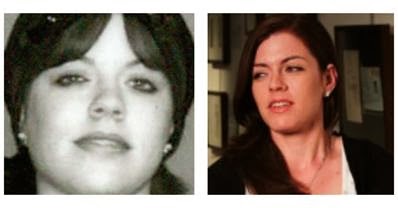
Frimet Goldberger, Satmar wife will no longer shave her head!

Then and Now: Frimet Goldberger used to wear and wig and a hat over her shaved head (left). Today she grows her hair long.

by Frimet Goldberger
I remember the first time I felt the cold, prickly air on my newly shaved head. I remember looking in the mirror. I remember staring at the pile of auburn hair in the vanity sink of the cozy basement apartment I now shared with my husband of less than a day. I remember my mother gathering the hair into a garbage bag and disposing of it, unaffectedly. I remember placing the new wig on my bare head and fussing over the few stray hairs the shaytl makher, or wig stylist, forgot to spray into place.
The morning after my wedding, three months after my 18th birthday, my mother shaved my head, and I felt absolutely nothing. Was I supposed to feel sad at this loss? Was I supposed to feel violated? I did not. Married women shave their heads because Hashem and the rebbe command them to do so. According to the Talmud, a woman’s uncovered hair is equivalent to physical nudity. Hasidic rabbis have taken this a step further, requiring women to shave their heads to ensure that not a single hair is seen. For Satmar women like me, it is a grave sin not to shave. You would not be buried in the Satmar beys-hakhayim, and if that weren’t serious enough, you would also put your children, live and unborn, at imminent risk of terrible diseases.
The Satmar Rebbe, Yoel Teitelbaum, famously gave emotional, tear-jerking speeches against married women growing their own hair. “Jewish daughters, our mothers and fathers gave up their lives to our Father in Heaven for the sanctity of His name, but you, their daughters, don’t want to give up even a few hairs?” he asked in a speech on Yom Kippur eve in 1951, according to “The Rebbe,” a 2010 biography by Dovid Meisels. “What does Hashem Yisbarach (God) ask of us? A few hairs! Because of a few hairs you are making yourselves lose both worlds. Jewish daughters, shave your hair and give honor to the Torah.”
The last time I buzzed off my hair — exactly five years ago — was nothing like that first time. The anniversary marks a pivotal juncture in my life, a point of momentous change that led me on a path to a new life. The day before that final shave, on an unusually warm October night, my husband and I sat at an oblong wooden table in a side room of the main Satmar synagogue, in the upstate New York village of Kiryas Joel. At the table were eight middle-aged men in black hats and suits; they sported long gray-and-white beards. I sat with my trembling hands folded on my lap and adjusted my long black skirt — part of the uber-modest ensemble I had carefully chosen hours before — for the umpteenth time, and awaited the storm.
I knew we were in trouble the moment I saw the letter on the official United Talmudical Academy stationary in the mail. The letter was curt and stated unequivocally that because of my failure to dress in accordance with the stringent tznius, modesty, rules of the holy shtetl, our 3-year-old son could no longer attend school. After the shock wore off, my husband and I scrambled to arrange a meeting with the Va’ad Hatznius — the mysterious group charged with maintaining the highest standards of modesty, especially for women. The group was known to resort to extreme measures, such as slashing car tires, when warnings and threats did not work to restore modesty.
As I sat at the table with the Va’ad Hatznius, the head of the group told my husband and me that it could no longer tolerate my modern clothing. This is a holy shtetl, and the rebbe would be horrified if he were still alive, he said in Yiddish, while swaying side to side in his folding chair. Another man chimed in to say he also heard that I have bei-hur, a derisive term used to describe hair on a married woman. They couldn’t confirm it, he said, but oy vey to my family and me. What a disgrace.
I looked down at my dark shoes and thick beige stockings. How did the Va’ad Hatznius find out? It must have been the neighbors who saw a stray hair, who noticed that I wore the same turban all the time. It was the only turban I could find that would fit on top of the large, white knit kippah I bought in the hosiery shop, the type that Hasidic men wear to sleep at night, which held my mass of hair securely in place. I would spend many hours a day with these neighbor women while my children were playing outside. They must have ratted me out. Or, perhaps, the mikveh attendant reported me because I had been absent for more than a year. Since my hair had started to grow out, I had stopped making the monthly trip to the strict Kiryas Joel mikveh to do the ritual bathing after menstruation, as required by Jewish law. Instead, I went to a mikveh in Rockland County, N.Y., where women with hair are allowed to bathe. I knew that the Va’ad Hatznius was going to catch on to my secret at some point, and now it had.
The group would send a woman to my house to check my head, the older man across from me said — all while keeping his right hand over his eyes to shield me from view. He spoke to my husband, never directly to me.
We left the synagogue, pale and worn down. My husband had tried desperately to counter their allegations, to keep our last strings to our community intact, to get our son back into the only yeshiva he could attend. There was no debating that we would have to prove our commitment to the group. We reasoned that if we rewound the clock, if I returned to the person I was — a model of Hasidic modesty — perhaps the group would let us stay in the place we were born and bred. I needed to lengthen my skirt, buy bigger shirts, cover my wig with a wider headband and, of course, shave my head.
I arrived back home, removed the dusty shaver from the linen closet and stared at my reflection in the mirror. It felt wrong, oh so very wrong, to shave. I felt violated and intimidated. But the thought of being revealed was worse. A woman would ring my doorbell tomorrow, ask me to remove my turban, and see all of my hair. Oh, the humiliation, the shame. My mother, my friends and the community would discover my secret. My son would lose his spot in school. I had no choice.
The decision to stop shaving was not a conscious one. When I became pregnant with my second child, I stopped visiting the mikveh. Once I was out of view of the mikveh attendant, there was no one to scrutinize my head. I simply let my hair grow out, anticipating the inevitable shave after my daughter’s birth. At this point in our marriage, my husband and I had forged friendships outside the little enclave of Kiryas Joel and discovered the vast population of pious Orthodox, and even Hasidic, Jews who didn’t shave their heads. The movies we covertly watched at home with the shades drawn, the illicit vacations we took — they all influenced my decision to forgo shaving. I still felt immense guilt at the thought of condemning my family to hell, and the feeling followed me like a haunting shadow.
But then my beautiful daughter arrived one cold January evening. I continued to let my hair grow. I felt like a woman again, even if my hair went uncovered for only a few hours a day, in the safe confines of my own home. It felt too good to let it go.
Standing in front of the mirror after my meeting with the Va’ad Hatznius, I knew I had skirted the inevitable for too long. Within three minutes, my long auburn hair lay in a sad heap in the same sink as it had five years earlier. I cried onto my clipped hair, hot tears of frustration, anger and humiliation.
That night, my husband and I could barely sleep. The next morning, we decided to leave the community for good. We no longer felt capable of maintaining an extreme Hasidic lifestyle. We ached for a little freedom, for the leash around our necks to be loosened, for my hair to be left in its rightful place, to grow or show as I pleased.
It has been five years. Many lifestyle changes and adjustments later, I no longer cover my hair as many of my Orthodox peers do, and I am no longer capable of accepting, let alone understanding, the practice of forced head shaving, much less the threats and intimidation used to maintain it within the community. But I am grateful for the fact that this very last, most personal violation of mine led my husband and me to gather the strength to take control of our lives and to make decisions for ourselves, our children and for me — my own body.
Frimet Goldberger is a radio producer, documentarian, writer and full-time mother of two children. She is set to receive her Bachelor of Arts from Sarah Lawrence College in December.


Friday, November 1, 2013

Chassidishe Meshigner who converted to Islam charged with threatening Jews


 A New Jersey man who co-founded a radical Islamic website has pleaded guilty to using the Internet to make threats against Jewish groups.

Yousef Mohamid al-Khattab, 45, of Atlantic City started the now-defunct Revolution Muslim website in 2007 with partner Jesse Curtis Morton.

Al-Khattab, who converted from Judaism and was previously known as Joseph Cohen, is the third person connected with Revolution Muslim to be convicted in federal court in Alexandria.

Morton and another man, Zachary Chesser, admitted using the site to deliver thinly veiled threats against the creators of the "South Park" television show for perceived insults to the prophet Muhammad.

Al-Khattab's guilty plea, announced today, does not mention the "South Park" threats. In court documents, al-Khattab admits encouraging readers to take unspecified action against Jewish leaders.

In some postings, he provided names and addresses of Jewish leaders and synagogues and urged Muslims angered by the Israeli-Palestinian conflict to "deal with them directly at their homes."

In another posting he praised Fort Hood shooter Nidal Hasan for "13 knockouts," a reference to the 13 people Hasan shot and killed in the 2009 attacks.

Al-Khattab faces up to five years in prison at a sentencing scheduled for Feb. 7. His lawyer, Alan Yamamoto, said it is not yet clear what length of term will be recommended under the federal sentencing guidelines.

Thursday, October 31, 2013

Machlokas between Litvishe "Gedolei Yisroel" intensifies; Students and kollel guys thrown out of yeshivas that supported Rav Auerbach shlita


The widening split in the litvish Torah community, is reality, and a most unpleasant and worrisome one. In line with the reported decision of HaGaon HaRav Aaron Yehuda Leib Shteinman Shlita and HaGaon HaRav Chaim Kanievsky Shlita, many avreichim in kollelim are indeed being compelled to sign a document requesting mechila and pledging future allegiance to gedolei yisrael in Bnei Brak. It has been reported that Rav Avraham Rubinstein’s Kollel Nachlas Moshe is compelling avreichim to sign, as is the kollel of HaGaon HaRav Sholom Ber Sorotzkin and others. According to Kol Berama Radio reports as many as “hundreds” of avreichim may have already been ousted from their beis medrash. Chareidi radio stations are chock full of interviews, presenting spokespersons from both sides, Bnei Brak and Yerushalayim. The situation is not a heartwarming one. The escalating machlokes is evident in many areas, including the chareidi print media. What is clear is that on the grassroots level, talmidim of Rav Shteinman and Rav Kanievsky Shlita along with talmidim of HaGaon HaRav Shmuel Auerbach Shlita are being compelled to select sides. A division is being placed in the machane at this critical time when enemies of Torah Jewry are working tenaciously to stamp out limud Torah in Eretz HaKodesh. While many or most avreichim may be signing there are many who are refusing, adhering to the instructions of their rav, HaGaon Rav Auerbach. A growing number of lomdei Torah are rapidly finding themselves outside the beis medrash and the division is becoming increasingly evident. The Torah HaKadosha, once the uniting force is now being used to divide, all “L’Shem Shomayim”. On the front page of the Yerushalmi faction-affiliated HaPeles is a clear message from Rav Auerbach. “Don’t sign!” The notice adds that a sum of money has already been contributed to serve as a base for a fund to assist avreichim who are ousted, YWN-ISRAEL has spoken with rabbonim and individuals on both sides and some seem to posit that gedolei yisrael shlita are being “manipulated by the powerbrokers that have access to them”. Once again, YWN-ISRAEL is not going there. Others posit that even if this is the case, gedolim shlita must be responsible and their words cannot be discarded by attributing it to askanim and powerbrokers. At this stage it is difficult to predict where this will end. What is clear however is that many bnei torah are confused, concerned and worried as they realize their home, the beis medrash, may now be off limits to them because they remain committed to the instructions of their mora d’asra. Some rabbonim posit that what is really worrisome is that the division will weaken the chareidi tzibur and this will become apparent in the real battle, the battle to induct bnei torah into the IDF and to compel mosdos to accept secular subjects in the curriculum. And on a final note, HaGaon Rav Auerbach is quoted in Thursday’s (27 Cheshvan) HaPeles once again instructing bnei torah not to cooperate with IDF induction officials in any way whatsoever – not to report to induction centers and not to fill out any forms. HaGaon HaRav Shteinman Shlita feels one should report and fill out the basic form requesting identification information and a signature. In directly related matters, Education Minister Shai Piron announced that the ministry will cut funding to any institution that discriminates due to one’s political affiliation. In essence, from a political perspective one can easily argue that Piron is correct since the machlokes surrounds those who voted Bnei Torah instead of Degel. Whatever the case, the minister’s decision will lead to cutting the little funding that remains. from the beis medrash roster and now find themselves without a source of parnasa. Such avreichim are instructed to phone for assistance. The notice is signed by “HaRav Chaim Katz in the name of the Vaad Roshei Yeshivos”.

Wednesday, October 30, 2013

Mendel Tewel arrested for sexual abuse, Video


  • Married rabbi, 30, arrested at Jewish youth centre in Beverly Hills for 'sexually molesting boys' in New York.


  •  Menachem Tewel, 30, also known as Mendel Tevel, was arrested at the JEM Community Center on S. Santa Monica Boulevard, in Los Angeles, California He is suspected of abusing four boys between 1995 and 2004 The incidents happened in Brooklyn where he lived and at a sleep-away camp in Pennsylvania.


  •  One alleged victim says Tevel performed oral sex on him several times in his car when he was 14 Another claims Tevel spanked his naked body with a ping-pong bat multiple times.


  •  Tevel is married to Bracha, the daughter of JEM's director, Rabbi Hertzel Illulian Tevel is facing extradition to New York.


 A rabbi accused of sexually abusing boys in New York was arrested Tuesday afternoon at a Jewish community center in Beverly Hills, California. 
Menachem Tewel, 30, also known as Mendel Tevel, was handcuffed and led away from the JEM Community Center at 9930 S. Santa Monica Boulevard, at around 1.30pm, where he was working a youth worker. He is suspected of abusing four boys between 1995 and 2004 on two counts of criminal sexual acts and one count of sexual abuse. 

Tevel is accused of carrying out two of the acts in Brooklyn and two at Machane Menachem, a since-closed Chabad-Lubavitch sleepaway camp in Lackawaxen, Pennsylvania, where Tevel worked in 2001.
 He also worked as a mentor at the now-closed Shterns Yeshiva in upstate New York, according to the Jewish Journal. All of the boys are now adults, including one who says Tevel performed oral sex on him several times in his car when Tevel was 22 and the alleged victim was 14, according to the New York Post. 

The rabbi moved to Los Angeles and had recently been working at the JEM Center, a Jewish youth community center in Beverly Hills. 

The JEM Center’s director, Rabbi Hertzel Illulian, is Tevel’s father-in-law. Illulian’s daughter, Bracha, married Tevel in 2012, according to the Jo ‘No child, no parent, no one has alleged anything against the JEM Center,’
JEM Community Center in Beverly Hills, Los Angeles, California, where he was working as a youth worker
 Dana Cole, an attorney for the JEM Center, told reporters in Los Angeles. ‘This involves activities that occurred several years ago in New York City.’ 
Wife: Tevel is married to Bracha, pictured, the daughter of his boss at JEM, Rabbi Hertzel Illulian, director of the centre
Jewish Community Watch, an organization that focuses on child abuse prevention, said it alerted local rabbis about the allegations against Tevel in August. 

The Journal had reported that four men said they had been victims of Tevel when they were minors, ranging from ages 6 to 14 at the time of the alleged abuse. They claimed Tevel performed acts that included spanking on bare skin, to sexually suggestive rubbing.

 One alleged victim, now 25, told the Journal that Tevel’s abuse might have begun at a very early age. The 25-year-old, who did not wish to be named, said when he was 6 or 7 years old, his family lived near Tevel’s family in Brooklyn. He said Tevel, then 11 or 12 years old, would go to the basement of his home multiple times per week with him, lock the door, tie him down, remove some or all of his clothing, and whip him. ‘I had just a T-shirt on and socks,’ he told the Journal. ‘Of course, pants and any sort of underwear, that was gone.’ 
The alleged victim, who was raised an observant Jew, said he has since attended therapy for years after that. 
Another man, 21, said he was about 9 years old and Tevel was about 18, when he was a first-time camper at Machane Menachem. One day, he alleged, Tevel brought him into a sports equipment room. As another person watched the door, the 21-year-old man claimed, Tevel bent him over his lap and smacked him on the rear with a pingpong paddle. He then pulled down his bathing suit and continued smacking him. Tevel will be extradited to New York, according to police.