“I don’t speak because I have the power to speak; I speak because I don’t have the power to remain silent.” Rav Kook z"l

Monday, March 10, 2025

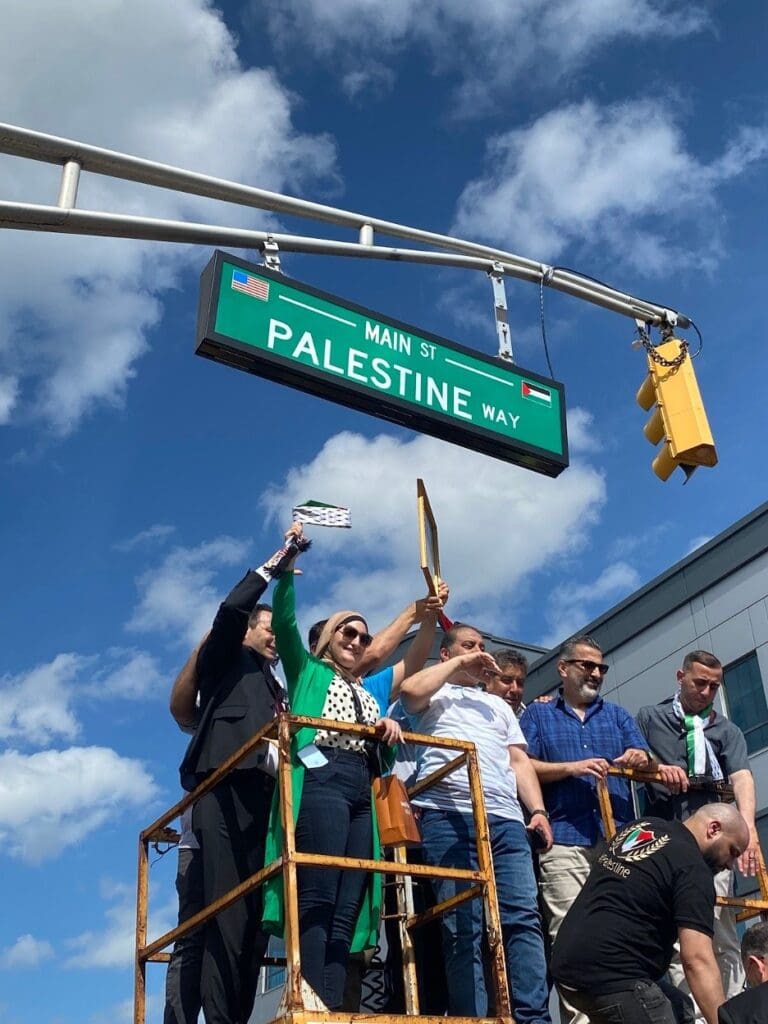
Paterson Is the Capital of Palestine in the United States of America ,,, Mayor of Paterson


Paterson, New Jersey, is undergoing a rapid transformation, with local leaders emphasizing Islamic identity and Palestinian nationalism, sparking concerns among critics about the city’s shift away from its historical roots.

The recent Hilal Lighting Ceremony, a city-endorsed event marking Ramadan, is seen as more than a religious celebration, but a political rally for Palestinian nationalism. The ceremony took place in “Little Palestine,” an area of the city now officially renamed Palestine Way in 2022.

Paterson, home to a growing Palestinian population, has seen its streets lined with Palestinian flags and Arabic signage. This cultural shift, led by Muslim elected officials, has led some to question if the city is evolving into an Islamic stronghold.

Muslim politicians, including Mayor Andre Sayegh, Councilmen Shahin Khalique, MD Forid Uddin, and Ibrahim Omar, as well as Deputy Mayor Raed Odeah, are at the forefront of this shift. The officials have championed policies catering to Islamic interests, such as halal food in public schools, school closures for Eid, and the broadcasting of the Adhan (Islamic call to prayer).

During the Hilal Lighting Ceremony, Mayor Sayegh declared Paterson “the capital of Palestine in the United States,” and referred to it as the “fourth holiest city in the world” after Jerusalem, Mecca, and Medina. These statements, along with efforts to prioritize Islamic practices in the city, have raised concerns about the future direction of Paterson.

The event was supported by several organizations with strong pro-Palestinian ties, including the Palestinian American Community Center (PACC) and the Islamic Center of Passaic County (ICPC), both of which have been accused of promoting radical pro-Palestinian and anti-Israel rhetoric.

The political shift in Paterson has led to questions about the role of Islamic influence in American cities and the line between cultural representation and political activism. Critics argue that the city’s transformation into an Islamic and Palestinian enclave could undermine the values that have traditionally defined Paterson.

As Paterson continues to evolve, the city’s identity remains a contentious issue, with Muslim leaders asserting their political and religious influence and others raising concerns about the implications for the broader community.

Sunday, March 9, 2025

Biden's 'autopen signature' appears on most official docs, raising concerns over who controlled the WH


The majority of official documents signed by President Joe Biden allegedly used the same autopen signature, reinvigorating concerns over the former president’s mental acuity and if he "actually ordered the signature of relevant legal documents," a report published by an arm of the Heritage Foundation found. 

"WHOEVER CONTROLLED THE AUTOPEN CONTROLLED THE PRESIDENCY," the Oversight Project, which is an initiative within the conservative Heritage Foundation that investigates the government to bolster transparency, posted to X on Thursday. 

Israeli universities threaten to strike if attorney general fired ...but "ISRAEL NOT FRIGHTENED!"


The heads of eight research universities in Israel published a declaration on Sunday threatening to strike if Attorney General Gali Baharav-Miara is dismissed.

This comes after Justice Minister Yariv Levin initiated proceedings to replace Baharav-Miara, following several public spats between government leaders and the attorney general. 

The signatories of the document are: Professor Daniel Chamovitz, president of Ben-Gurion University of the Negev; Professor Gur Alroey, president of the University of Haifa; Professor Alon Chen, president of the Weizmann Institute of Science; Professor Asher Cohen, president of the Hebrew University of Jerusalem; Professor Uri Sivan, president of the Technion - Israel Institute of Technology; Professor Ariel Porat, president of Tel Aviv University; Professor Arie Zaban, president of Bar-Ilan University; and Professor Leo Corry, president of the Open University.

"The signatory presidents of the universities hereby warn of an unprecedented danger to the rule of law in the State of Israel if the government's attorney general is dismissed," they wrote. "In the democratic regime that rules in Israel, the attorney general is the most important guardian against possible government infringement of civil rights and private rights of the country's residents. She is the one who maintains proper policing. She, together with the courts, represents the arrow between a democratic rule in which checks and balances on the government are necessary, and a tyrannical dictatorship in which the government can do whatever it wants," they said.

"The legal adviser is a public servant, not a politician. Her only 'sin' is that she fulfills her role with great professionalism and courage," the letter continued. "Therefore, the calls by ministers in the government and members of the Knesset for her dismissal are nothing but calls to get rid of the rule of law. Any harm to the rule of law will result in severe damage to Israeli society, including the economy and security. If the legal adviser is dismissed, we will declare our personal strike, protest against the move, and call on others to do the same. We implore these parties to declare their intention to act as soon as possible."

Education Minister Yoav Kish wrote on his X account in response: 

"I just answered the heads of the universities – you are confused. Threats of a strike to influence policy do not frighten us. The end of democracy will not come because of the attorney general's resignation, on the contrary – finally, the people's will be expressed. An attorney general who opposes the government in every action from her first day is not worthy to remain in her position, and therefore the dismissal process has begun. It would have been better had she resigned on her own initiative."

Syria's new regime accused of massacring 1000 civilians


Syrian security forces entering the western town of Baniyas in Syria's coastal province of Tartus to reinforce government troops

Over 1,000 people were killed in two days of fighting in Syria between security forces under to the new Syrian Islamist leaders and fighters from ousted president Bashar al-Assad's Alawite sect on the other hand, according to the Syrian Observatory for Human Rights on Saturday.

The victims included 745 civilians, 125 members of the Syrian security forces, and 148 fighters loyal to Assad, the UK-based Observatory said. These figures have not been verified by major international news outlets.

Al Jazeera said that, as of Sunday, 231 members of the regime forces had been killed.

The intense fighting broke out late last week as the Alawite militias launched an offensive against the new government's fighters in the coastal region of the country, prompting a massive deployment ordered by new leader Ahmed al-Sharaa.

"We must preserve national unity and civil peace as much as possible and... we will be able to live together in this country," al-Sharaa said, as quoted in the BBC.

The death toll represents the most severe escalations since Assad was ousted late last year, and is one of the most costly in terms of human lives since the civil war began in 2011.

The counter-offensive launched by al-Sharaa's forces was marked by reported revenge killings and atrocities in the Latakia region, a stronghold of the Alawite minority in the country.


President Trump, keep up the crackdown on campus antisemites


The speed and scope of actions coming from Donald Trump’s White House remain breathtaking.

Among other big moves Friday, the 46th day of his administration, the president said he was “strongly considering” imposing sanctions and tariffs against Russia until it agrees to a peace deal in Ukraine.

He also said America will offer a rapid pathway to citizenship for South African farmers whose government is threatening to confiscate their property.

And Trump revealed that he sent a letter to the Iranian government with an offer to negotiate a deal to prevent Tehran from acquiring a nuclear weapon.

Other comments concerned the on-again, off-again tariff programs and his warning to Hamas to release all hostages “or there would be hell to pay.”

All of these issues are incredibly important, but for my taste, the most significant action Friday involved none of the above.

It was the administration’s announcement that it was canceling $400 million in federal grants and contracts given to Columbia University over its failure to address rampant antisemitism on its Manhattan campus.

It followed, by one day, a State Department announcement that it had yanked the first visa of a foreign student linked to “Hamas-supporting disruptions.”

Although the student and the school involved were not identified, it’s a certainty the twin developments are sending shock waves through colleges and universities across the nation — and that’s the point.

The moves lower the boom on the campus radicals, including professors, who are supporting the murderous terrorist organization and the feckless university administrators who have done little or nothing to stop them.

Reports indicate that grant cancellations for other schools will soon follow, with officials from the Department of Education saying recently they were conducting investigations of five universities where repeated antisemitic harassment incidents were reported.

Columbia was one of the five, with the others being Northwestern University, Portland State University, the University of California, Berkeley, and the University of Minnesota, Twin Cities.

“Universities must comply with all federal antidiscrimination laws if they are going to receive federal funding,” Education Secretary Linda McMahon said Friday.

“Columbia has abandoned that obligation to Jewish students studying on its campus.”

It’s possible that Yale, another Ivy League school, could be in the crosshairs.

It received a “D” in a recent Anti-Defamation League report card over the distribution of antisemitic flyers on campus and an anti-Israel rally where protesters chanted, “Free our prisoners, free them all, Zionism must fall.”

Secretary of State Rubio ‘Frustrated’ Feels ‘Sidelined"


Secretary of State Marco Rubio is reportedly frustrated by being sidelined in major foreign policy decisions. 

Despite his hawkish stance on Russia and support for Ukraine, Rubio has found himself out of the loop, with President Trump appointing multiple envoys for key issues without his consultation. 

American Airlines and the other Airlines That Still refuse to Fly to Israel


Roughly a year and a half after Hamas’s Oct. 7 terror attack prompted major airlines across the globe to pause flights to Israel, many of them still haven’t resumed service or said when they plan to do so—including in countries led by bitter opponents of the Jewish state.

Domestically, American Airlines and Delta continue to pause their flights into Israel, citing a tumultuous security situation. Delta intends to restore service from New York’s JFK Airport on April 1, offering 2,000 weekly seats to passengers, an airline spokesman told the Washington Free Beacon. American Airlines flights, meanwhile, remain in limbo. An airline spokesman said that service to Tel Aviv is not slated to resume at this point.
“American continuously evaluates its network and we have nothing new to share at this time regarding Tel Aviv service,” the spokesman said, noting that the airline does offer service through its partners. “Customers who are planning travel to Israel can purchase tickets on aa.com on flights operated by our partner airlines that serve Tel Aviv.”
Scores of international carriers have similarly declined to announce a date for their resumption of flights to Israel. Here is a collection:

Trump Shocked: 'Wasn't anyone there kind?


US President Donald Trump expressed his surprise after meeting with released hostages earlier this week, learning that none of their Hamas captors showed them any kindness.

"I said, ‘Did you see anybody in there who was kind? They said no,’" Trump recalled while speaking to reporters in the Oval Office.

He continued, "The answer was nobody. There was nobody. Just the opposite. They’d be slapped and punched. One man broke his ribs. He couldn’t breathe for a month. It was brutal,’" which seemed to reference the testimony of recently freed hostage Eli Sharabi.

"I was so surprised. Because you think there’d be a couple of people that would be kind, that would say, ‘You’re going to be okay.’ But they had none of that. It’s pretty amazing," Trump added.

Hundreds of Chareidim Daven At Rav Ashi’s Kever On Lebanon Border With IDF Escort


by Fayga Marks 

Over the past few years, I’ve visited countless Jewish heritage sites across Israel—some famous, some nearly forgotten, and many that are only accessible under special security arrangements. Each visit has been a chance to reconnect with our history, but this time, I knew it would be different.

When I saw the rare opportunity to visit the Kever of Rav Ashi, buried near the Israeli-Lebanese border, I understood this was a once-in-a-lifetime experience. Few people have ever stepped foot here, and visits are almost never permitted.

 Just a few weeks ago, a group of 20 Breslov chassidim arrived at the site without proper IDF coordination. Their attempt to access the tomb caused a serious security incident, as they snuck across the Israeli-Lebanese border without permission, which could have led to dangerous consequences. This was a place where every step required approval, every movement was monitored, and every moment carried both spiritual weight and real risk.

I knew the journey would be long—at least 6 to 10 hours—and that security restrictions would be tight. The IDF only approved a very small number of visitors, and out of nearly 800 people who went, I was the only woman. 

Our journey began in Jerusalem, with a short stop at Meron to visit Rashbi’s kever before continuing north. As we approached the border, the reality of what we were about to do set in. We were walking through a military zone, in complete darkness, knowing that our enemies were watching us from just meters away.

The Kever of Rav Ashi, together with that of Rav Papa, is mentioned in Sefer Yichus Avos as being located on Har Shanan. But for over two decades, the site had been inaccessible. It was abandoned in 2000 when Israel withdrew from Lebanon, and for security reasons, the IDF stopped allowing visitors altogether. Now, the site is divided by a barbed wire fence, with an IDF outpost stationed on the Israeli side. Access is only granted under strict military escort.

We were told to stay within a specific area, not to use flashlights, not to take photos—every action had to be carefully measured. The kever itself had recently been repainted blue by Breslov chassidim, marking the first effort in years to maintain the site. But even that was a quiet battle, a reminder of how much effort it takes to preserve our history in places where our presence is not guaranteed.

This was the first officially approved visit to Rav Ashi’s kever in five years. That fact alone is staggering. It made me realize something painful: so much of our history is being forgotten. How many sites like this—holy places, places of deep significance—are being left behind? How many will disappear in 50 or 100 years if we don’t fight for them now?

I’ve been to Kever Yosef in Shechem countless times, a site that also requires heavy security. But this was different. The tension, the weight of history, the feeling that if we don’t stand here today, there may not be a tomorrow for these places.

I didn’t just go to say a prayer. I went to take responsibility. To walk, to see, to feel—to understand, with my own eyes and hands, what it means to fight for our heritage.

For centuries, Jews have preserved our past through learning, through prayer, and through storytelling. But we must also preserve it through action. We cannot just visit the places that are easy and convenient—we must fight for the places that are fading from memory.

I want to thank Netanel Snir and the Kever Yosef Administration for making this possible. Their relentless work, along with the IDF soldiers who risk their lives to protect these places, is the reason we can still stand at sites like this today.
This wasn’t just a journey. It was a statement. That we will not forget. That we will return. That no place is too far, too dangerous, or too forgotten—because our history lives in the land, and we will never abandon it.

And for me? It was worth every moment.

FAT Nadler Slams Trump for Canceling $400 Million of Grants to Columbia Univ


Once again, Congressman Fatso Jerrold Nadler (NY-12) has proven that his loyalty lies not with Americans or his own Jewish people, but with the far-left ideology that has overtaken the Democratic Party. 

In a shameful statement, Fat Nadler and fellow progressive Rep. Adriano Espaillat (NY-13) slammed the Trump administration’s decision to revoke $400 million in federal grants to Columbia University, an institution that has allowed antisemitic harassment to flourish unchecked.

Nadler and his allies claim that pulling these funds isn’t about combating antisemitism, but about waging a “war on education and science.”

Columbia University has been a hotbed of anti-Jewish hate, with Jewish students facing harassment, threats, and intimidation. Yet, instead of standing up for his own people, Nadler is more concerned with protecting the woke academic elites who have done nothing to ensure the safety of Jewish students.

This is nothing new for Nadler. Time and again, he has abandoned Jewish interests in favor of radical leftist policies. In 2015, he backed the disastrous Iran nuclear deal, turning his back on Israel and aligning himself with a regime that openly calls for the destruction of the Jewish state. His betrayal was so blatant that many accused him of stabbing Israel in the back.

Now, with antisemitism surging on college campuses across the country, Nadler had another chance to do the right thing. Instead, he chose to play politics, accusing Trump of using antisemitism as a “ploy” rather than acknowledging the reality that Columbia has failed its Jewish students. His suggestion that pulling funding is about forcing universities to “align with the MAGA agenda” is not only dishonest but an insult to every Jewish student who has been harassed, threatened, or attacked simply for being Jewish.

Let’s call this what it is: a pattern. Fat Nadler consistently sides with those who put Jewish lives at risk. Whether it’s supporting a deal that empowers Iran, defending antisemitic rhetoric from the left, or shielding universities that allow antisemitism to fester, he has made it clear that Jewish safety is secondary to his political ambitions.

The Trump administration’s decision to revoke funding from Columbia is not an attack on education—it is a necessary measure to hold universities accountable for protecting all their students. If a campus allowed open hostility toward any other minority group, would Nadler be so quick to defend it? Of course not. But when it comes to Jewish students, he suddenly finds excuses.

Fat Jerry Nadler may be Jewish by birth, but his actions show that he has long since abandoned the values of his own people. He is the worst kind of politician—one who sells out his own for the sake of party loyalty. And history will remember him as exactly that.