
היינט אין קרעסטיר pic.twitter.com/7Qc93pI1n2
— Hasidic2 (@hasidic_1) April 14, 2021
היינט אין קרעסטיר pic.twitter.com/7Qc93pI1n2
— Hasidic2 (@hasidic_1) April 14, 2021
The CNN staffer who was secretly recorded admitting the network used “propaganda” to help get Joe Biden elected president also said they played up the COVID-19 death toll for ratings — and that the order came down directly from top brass.
Charlie Chester, a technical Director at the cable network, was filmed by Project Veritas during a series of fake Tinder dates as he explained how “Fear really drives numbers.”
“COVID? Gangbusters with ratings,” Chester told the unidentified PV staffer.
“Which is why we constantly have the death toll on the side,” he continued, making reference to the coronavirus death tracker that would appear on the screen. “It would make our point better if [the COVID death toll] was higher.”
The Project Veritas employee, who was not identified and claimed to be a nurse, went on five dates with the CNN staffer, including the final one at a coffee shop in Chester’s neighborhood. It’s unclear when the dates took place.
On one of the meet-ups, Chester explained to the PV employee why the network went so heavy on COVID coverage, saying, “Fear is the thing that really keeps you tuned in.”
Going on to reference the death toll, Chester then said he had “a major problem with how we’re tallying how many people die every day, because I’ve even looked at it and been like, look at it and be like, ‘Let’s make it higher.’ Like, why isn’t high enough, you know, today?”
“And I’m like, what am I f–king rallying for? That’s a problem that we’re doing that,” he conceded.
Chester claimed there was a “red phone” that network president Jeff Zucker would use to call the control room to order producers to play up the Covid death count on screen.
“Like, this special red phone rings and they pick it up and it’s, like, the head of the network being like, ‘There’s nothing that you’re doing right now that makes me want to stick. Put the numbers back up. Because that’s the most enticing thing that we have.’ So things like that are constantly talked about,” the staffer said.
He also told his date that there is “no such thing as unbiased news,” and explained how that manifests at CNN.
“Any reporter on CNN, what they’re actually doing is they’re telling the person what to say. It’s always, like, leading them in a direction before they even open their mouths,” he said.
“And the only people we let on air, for the most part, are people that have a proven track record of taking the bait.”
A CNN spokesperson did not immediately respond to The Post’s request for comment on the second part of the Project Veritas report.
In part one of the PV series, Chester was seen revealing that his network produced “propaganda” to oust former President Donald Trump during the 2020 presidential election
“Look what we did, we [CNN] got Trump out. I am 100 percent going to say it, and I 100 percent believe that if it wasn’t for CNN, I don’t know that Trump would have got voted out,” Chester said, adding that he came to work at CNN because he ”wanted to be a part of that.”
“Our focus was to get Trump out of office, right? Without saying it, that’s what it was.”
THANKS SO MUCH,, IT MEANS THE WORLD TO US IN THESE DIFFICULT TIME
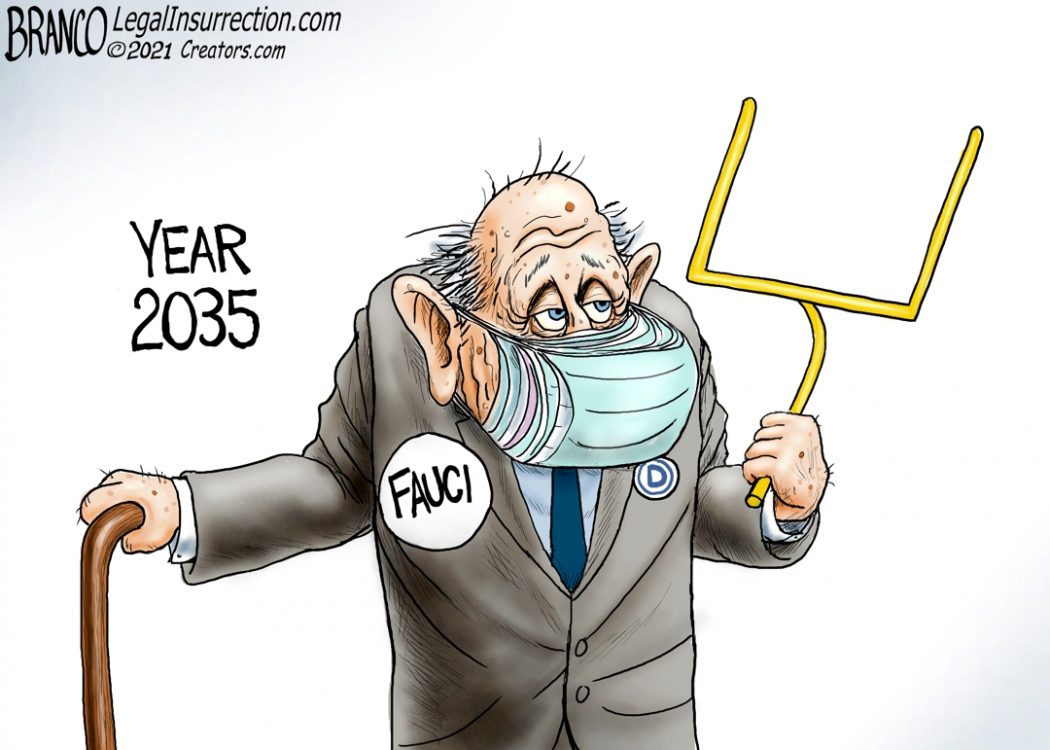
The best kept secret of the pandemic — kept secret especially by our perma-doom-saying public-health authorities — is that the COVID-19 vaccines work. They work very, very well. Yes, even the Johnson & Johnson product just put on pause because of a one-in-a-million side effect.
The vaccines have shown incredible results in fighting off serious cases of COVID-19. These shots are scientific miracles — and you should take one at the first opportunity.
Take the vaccine, wait two weeks after the final dose, and then return to your 2019 life. Or better yet, make up for the last miserable year by taking your 2021 life to the next level.
Take off your mask as much as you can. You will still have to wear it in shops that require it, or on the short but deadly walk to your table at restaurants (eye roll). But you don’t need it anymore to walk your dog, push your child on a swing, hug a friend. Outdoor masking was always more about virtue-signaling. But your going mask-less now signals something else: You’ve gotten the jab, you trust in the science and you are moving on.
Make plans. So many of us have been in a holding pattern for more than a year. See friends, and not just the ones you’ve bubbled with for the last year. Fill your weekends. Have brunch, lunch and dinner out. Go to a museum. Lounge in the park. Go on adventures. Fall in love with someone new or with your spouse all over again.
Remember why you love your city. Change out of your leggings. Get dressed up. Find somewhere to go dancing. Go laugh your face off at a comedy show. You have taken the vaccine, and the pandemic is effectively over for you. Celebrate that — hard.
THANKS SO MUCH,, IT MEANS THE WORLD TO US IN THESE DIFFICULT TIME

Democrats are preparing to unveil legislation that would add four seats to the US Supreme Court.
The bill, first reported by The Intercept, is expected to be introduced in both the House and Senate on Thursday.
It would up the number of seats on the high court to 13 from the current nine.
Massachusetts Sen. Ed Markey, a co-sponsor of the bill, told The Wall Street Journal that adding justices “will shore up the public’s confidence in the court and its legitimacy in the public’s eyes.”
Also backing the measure are House Judiciary Committee Chair Jerry Nadler (NY-10th District) Subcommittee Chair Hank Johnson (GA-4th District), and freshman New York Rep. Mondaire Jones.
The sponsors will announce the proposal at a press conference Thursday morning on the steps of the court, where they will be joined by activists from liberal groups including Take Back The Court, which has advocated for increasing the number of justices.
“Our democracy is under assault, and the Supreme Court has dealt the sharpest blows. To restore power to the people, we must #ExpandTheCourt,” Jones wrote on Twitter.
Conservatives currently hold the majority on the bench after former President Donald Trump’s appointment of Justice Amy Coney Barrett to replace the late Ruth Bader Ginsburg, a liberal icon.
It is believed Barrett — Trump’s third nomination to the court — will cement the conservative tilt for decades, prompting calls from Democrats to increase the number of justices, who have lifetime appointments.
President Biden on Friday signed an executive order creating a commission that would study the “pros and cons” of expanding the court.
But Markey said that, “We need more than a commission to restore integrity to the court.”
Republicans and legal purists decry the idea as “court-packing” and say it will undo the court’s historical insulation from politics.
Arkansas Sen. Tom Cotton, a Republican, blasted the Dems’ proposal, saying that “Packing the Supreme Court would destroy the Supreme Court.”
“The Democrats will do anything for power,” he wrote on Twitter.
“The moderate left is gone,” said President Trump’s former chief of staff Mark Meadows.
“This is who they are now. Open borders. Outlawing voter ID. Free healthcare for illegal migrants. And now court packing. This should be roundly rejected.”
Biden previously opposed adding seats.
Congress altered the number of justices on the court several times over the 19th Century from a low of five to a high of 10. The number was fixed at nine shortly after the Civil War.
In the 1930s, President Franklin D. Roosevelt unsuccessfully sought to expand the court after conservative justices ruled against some of his New Deal policies.
THANKS SO MUCH,, IT MEANS THE WORLD TO US IN THESE DIFFICULT TIME

 |
| Hillel Schwartz by the grave of his brother, Ezra Schwartz, who was killed in a Palestinian terror attack in Israel on Nov. 19, 2015 |
I remember Ezra every time my little brothers and I watch a Patriots or Yankees game, his most beloved teams. I see his infectious smile every time I step out of my comfort zone to reach out to someone new. And I laugh at his antics every Friday night when my family reads from the letters we received after his death, and we learn about how he choked down hot peppers on the camp bus or made ridiculous music videos in his bunkhouse at two in the morning.
His tragedy resonates with almost all who hear it. A Palestinian terrorist opened fire from inside a vehicle near the Etzion Junction in the West Bank, killing Ezra, along with an Israeli teacher and a Palestinian bystander. Ezra was studying as part of a gap-year program at a yeshivah in Beit Shemesh, and that day was on his way to deliver snacks to Israeli soldiers stationed near Efrat when he was shot. He was just 18 and preparing to attend Rutgers University after his year in the Jewish state.
When Ezra was killed, the entire Jewish community supported my family. There was so much sadness around the world. Everyone wanted to help us. We received condolence cards and letters from Ezra’s friends and acquaintances describing their interactions with him. Our friends carried us through those first few months. Strangers sent Hanukkah gifts. We felt honored to be Ezra’s family. In the midst of my tragedy, I felt so loved.
But for most Jews outside of our community of Sharon, Mass., south of Boston, Ezra’s impact has faded with time. Yom Hazikaron is a day for these Jews to remember their loss and rekindle the closeness the nation felt in the aftermath of his death. It’s a day to perpetuate the memory of my brother and everyone else who died for Israel.
But more than that, Yom Hazikaron is a day for my family and those like ours to realize that our loved ones have not been forgotten by world Jewry. Every mention of Ezra’s name brings us a bit of healing. It lets us know that we are not alone, that people still care. It even goes a little way towards bringing Ezra back to us. Every time someone does something in his memory, it shows us that even though he’s not here with us on earth, he is not totally gone; he is still with us, affecting our lives.
I have participated in communal Yom Hazikaron ceremonies ever since my brother’s death. But this year’s Masa Israel Journey ceremony was a new experience. For the first time, I was helping Ezra be remembered not by people who knew and loved him, but by thousands around the world who had never met him or even heard of him.
 |
| Ezra on far right with his siblings |
Once in a while, I wonder whether Ezra’s repeated mention really makes a difference. But then I see the impact his story has on each new person who hears it—and I realize that if Ezra can change even one more life, it is all worth it. At the filming of this year’s Masa Israel Journey ceremony, I was sitting next to a man and a woman from another Masa program. This may have been their first time in Israel. I looked a little different than most of the wreath-holders, so they asked about my story. I told them about Ezra—and I could see their faces change. One of them started crying. Most of the people I encounter already know about my family’s experience, so I seldom have the chance to see how my brother’s story can move those hearing it for the first time. Each reading of Ezra’s name gives new people the opportunity to look him up, read about him and be inspired by something he did.
I am now nearing the completion of my year in Israel, an opportunity my brother never had. He will never attend Rutgers, start a career or build his own family. But as long as people remember him, Ezra will never truly be gone. He will live on in our stories, in our actions and in the children who bear his name.
This Yom Hazikaron, please take a minute to think of my brother. Read a story about him and maybe even do something in his merit. Ezra excelled at enjoying life and helping those around him. My family and I also encourage you to share your stories in Ezra’s memory with us, if you feel compelled to. In acts of kindness, you will be returning to him a bit of the life that was ripped from him, from my family and from the Jewish people.
Hillel Schwartz is the brother of Ezra Schwartz, an American victim of Palestinian terror in Israel in 2015.
THANKS SO MUCH,, IT MEANS THE WORLD TO US IN THESE DIFFICULT TIME

Thousands of centrifuges used to enrich uranium has been damaged or completely destroyed at the Natanz nuclear site, a senior Iranian official stated on Tuesday.
Alireza Zakani, the head of the Iranian parliament’s research center, detailed the damage incurred in the attack in an interview on state TV.
Zakani’s statement seems to confirm remarks by Channel 13 News analyst Alon Ben-David, who said that Iran’s provocative announcement that it will begin increasing uranium enrichment to up to 60% is “not a significant threat.”
Ben-David explained that due to the extensive damage at Natanz, Iran will not be able to reach 60% enrichment there and although it maintains about 1,000 additional centrifuges at its Fordo plant, those centrifuges can only enrich uranium up to 60% in very small quantities.
An increase of up to 60% uranium enrichment is significant since it is a short step away from weapons-grade uranium.
Lt. Col. (ret.) Michael Segall, an expert on strategic issues with a focus on Iran, terrorism and the Middle East, and a senior analyst at the Jerusalem Center for Public Affairs, told JNS on Monday that the attack caused years of work to “go down the drain.”
“This isn’t the first time that centrifuges in Natanz have crashed in one way or another,” Segall said. “I’m not sure how many cascades [a group of centrifuges working together to enrich uranium more quickly] were destroyed there, and it is not clear what happened, but when a cascade breaks, this represents years of work that go down the drain.”
Segall also spoke about the political repercussions of the multiple attacks [attributed to Israel] on Iran’s “top-secret” sites, with Iranians mocking the regime on social media for being unable to protect its most critical assets.
“The regime has been exposed,” he said. “As it continues to absorb attacks, there is a growing erosion in its perception by the Iranian people, and certainly, by the Iranian diaspora.”
THANKS SO MUCH,, IT MEANS THE WORLD TO US IN THESE DIFFICULT TIME
קיוסק שלא לוקח כסף ביום הזיכרון מחיילים, מדהים. pic.twitter.com/azCzctr25C
— אריאל אלחרר (@ariel_elharar_) April 14, 2021
KINDLY SUPPORT OUR BLOG BY BROWSING THE ADS
THANKS SO MUCH,, IT MEANS THE WORLD TO US IN THESE DIFFICULT TIME

Bernie Madoff, the fraudster who ran a $17.5 billion Ponzi scheme ensnaring thousands of investors, including a long list of Jewish organizations and families, has died at 82.
The Associated Press reported Madoff’s death Wednesday at a federal prison in Butner, North Carolina.
Madoff was known as a selective money manager who made fantastic yet consistent profits for his clients until his entire operation was exposed as a scam amid the 2008 financial crisis. Madoff’s confession of his Ponzi scheme, in which he invented fake stock gains on paper and used new investments to pay off withdrawals from other investors, set off a virtual earthquake in the Jewish philanthropic world.
Among Madoff’s investors were European hedge funds, elderly retirees and a range of nonprofits. Among his victims were some of the most prominent Jewish institutions in the country, as well as Jewish celebrities like Holocaust survivor Elie Wiesel and Sandy Koufax, the Hall-of-Fame pitcher.
Madoff’s investors included Yeshiva University, elite Orthodox Jewish day schools in New York and Boston, Hadassah, the Women’s Zionist Organization of America, and other Jewish organizations and family foundations.
Many of those investors had met Madoff through the small world of Jewish philanthropy in New York and south Florida, and placed their money with his fund via friends of his such as Jeffrey Picower and J. Ezra Merkin, who operated hedge funds that invested heavily with Madoff. Merkin, a former president of the elite Fifth Avenue Synagogue in Manhattan, directed perhaps $1 billion of congregants’ money to Madoff, according to the New York Times.
So when Madoff, facing increasing pressure due to a national financial crisis, confessed his crime in 2008, the effects were felt across American Jewry. Following the confession, the Jewish Funders Network, which convenes Jewish donors, brought together 35 of the largest Jewish foundations to create a plan to provide emergency funding to some of Madoff’s victims.
Around that time, the Anti-Defamation League also documented an uptick in anti-Semitism that it concluded stemmed from the news of Madoff’s fraud.
The consequences of Madoff’s fraud have reverberated through the Jewish world for years. Some Madoff investors, such as Hadassah, had withdrawn more money than they invested over the years, and were subject to “clawback” suits in which they had to pay back the fictitious profits. While Madoff had claimed to be managing nearly $70 billion, most of that money (aside from what investors gave him) had never actually existed.
A trustee, Irving Picard, has spent the years since 2008 trying to recover the actual billions that Madoff stole. As of 2021, they had recovered and restituted more than $14 billion of the $17.5 billion Madoff took.
“They really felt that they had so much more money in their accounts,” Richard Greenfield, a lawyer who consulted for a handful of Madoff victims in Florida, told the Jewish Telegraphic Agency in 2018. “When they talk about their losses, they talk about the fictitious numbers in their accounts, and for some of them, it’s hard to explain: Your real loss wasn’t $200,000, it’s $10,000, which is what you put in.”
Madoff was born in 1938 in Queens, New York, and began working as a stockbroker in 1959. He married his wife, Ruth, that year and had two children. He originally made a name by investing in computerized stock trading in the NASDAQ market, and served as NASDAQ’s chairman.
He began managing private clients’ wealth in the 1970s. While he told Diana Henriques, who wrote a book about him, that the Ponzi scheme began in 1992, the federal prosecutor who led the criminal investigation of Madoff believes that Madoff started the scheme when he began his money-management business.
He collected accolades as his ostensible success grew. Madoff was named the treasurer of Yeshiva University, the flagship Modern Orthodox institution, and gained a reputation as a reserved but effective steward of Jewish organizational finances.
Then it abruptly ended. Madoff pleaded guilty and was sentenced to 150 years in federal prison. His two sons, whom he swore had no involvement in his fraud, predeceased him, one by suicide on the second anniversary of Madoff’s arrest.
He is survived by his wife, Ruth.
THANKS SO MUCH,, IT MEANS THE WORLD TO US IN THESE DIFFICULT TIME

To suggest that the Holocaust was the necessary price the Jews had to pay to return to their homeland after almost 2,000 years of destruction, exile and persecution, borders on the blasphemous.
However to overlook the inextricable juxtaposition of these two nationally defining events - the first bringing us down to the hellish depths of despair and the second raising us up to the dizzying heights of redemption- would be blinding oneself to the commanding voice of Jewish history.
And so I begin this essay with my first lesson in Zionism, which emerged from the ashes of Auschwitz.
It was the Shabbas of the weekly portion Ki Tavo, toward the end of the summer of 1952. I had known that the Rebbe of Sanz-Klausenburg had taken over the Beth Moses Hospital, where he had built a very large Bais-Medrish as well as a printing press to teach his disciples a trade, and I wanted to pray with the Chassidim that Shabbas morning.
When I arrived at the Bais-Medrish, I was amazed by the sea of black and white swaying figures that greeted my eyes, all newly immigrant Holocaust survivors. It was said about the Rebbe that although his wife and 13 children had been murdered, he had not sat shiva for any of them; he preached that those still alive must be saved with exit visas before one could be allowed the luxury of mourning for the dead. The Rebbe himself was among the last to leave Europe, insisting that the captain does not leave the sinking ship before its passengers.
I took a seat directly behind the Rebbe, who stood at his lectern facing the eastern wall and the Holy Ark, with his back to the congregation. The prayer was the most intense I had ever experienced, with no talking whatsoever, and chance individuals even bursting out in tears during varying parts of the service, apparently in response to a sudden association with painful memory.
Then the Torah reader began to chant the weekly portion. When he came to the passage known as the Tochecha, consisting of the curses that would befall the Israelites, he began to read (in accordance with the time-honoured custom) in a whisper and very quickly.
A sound suddenly came from the place of the Rebbe; he said only one word: "Hecher, Louder."
The Torah reader immediately stopped reading, and seemed to hesitate for a few moments. I could almost hear him pondering. Did the Rebbe actually say "louder"? Would the Rebbe go against the custom of Jews in all congregations to chant the curses rapidly and in a barely audible voice? The reader apparently decided that he had been mistaken in what he thought the Rebbe had said, and continued reading in a whisper.
The Rebbe turned around to face the congregation, banged on the lectern, his eyes blazing:
"Ich hub gezugt hecher, I said louder," he shouted out. "Let the RBS"O hear! We have nothing to be afraid of. We have already received all of the curses- and more. Let the Almighty hear, and let Him understand that the time has come to send the blessings!"
I was trembling, my body bathed in sweat. Many people around me were silently sobbing. The Rebbe turned back to his lectern, facing the wall. The Torah reader continued to chant the curses loudly, and distinctively, and in a much slower cadence.
At the end of the additional prayers, after Aleinu, the Rebbe once again turned to his congregation, but this time with his eyes conveying deep love,
"Mein tayere shevestern un brider, my beloved sisters and brothers, the blessings will come, but not from America. Indeed, G-d has promised the blessings after the curses, and He has already begun to fulfil His promise by bringing us home to Israel. May more blessings await us, but they will only come from Israel. Let us pack our bags for the last time. Our community is setting out for Kiryat Sanz, in Netanya, Israel."
Signed
Shlomo Riskin
Efrat
THANKS SO MUCH,, IT MEANS THE WORLD TO US IN THESE DIFFICULT TIME
THANKS SO MUCH,, IT MEANS THE WORLD TO US IN THESE DIFFICULT TIME
